

Author: Debra Donovan

Real Estate Agent with Park North Real Estate CA DRE# 01893222

Home / Author: Debra Donovan

Real Estate Agent with Park North Real Estate CA DRE# 01893222

Q1 2023 San Francisco Real Estate Market

San Francisco Real Estate

The first quarter of the year was a rocky one for the San Francisco real estate market. The confluence of rising interest rates, inflation, tech layoffs, and a deluge of rain all contributed to a slower than normal January and February, with buyers waiting to see what would happen and sellers postponing their home sales due to weather. Although the weather dried and buyers were back out in force in March, overall it was a lackluster quarter.

Median Sales Price:
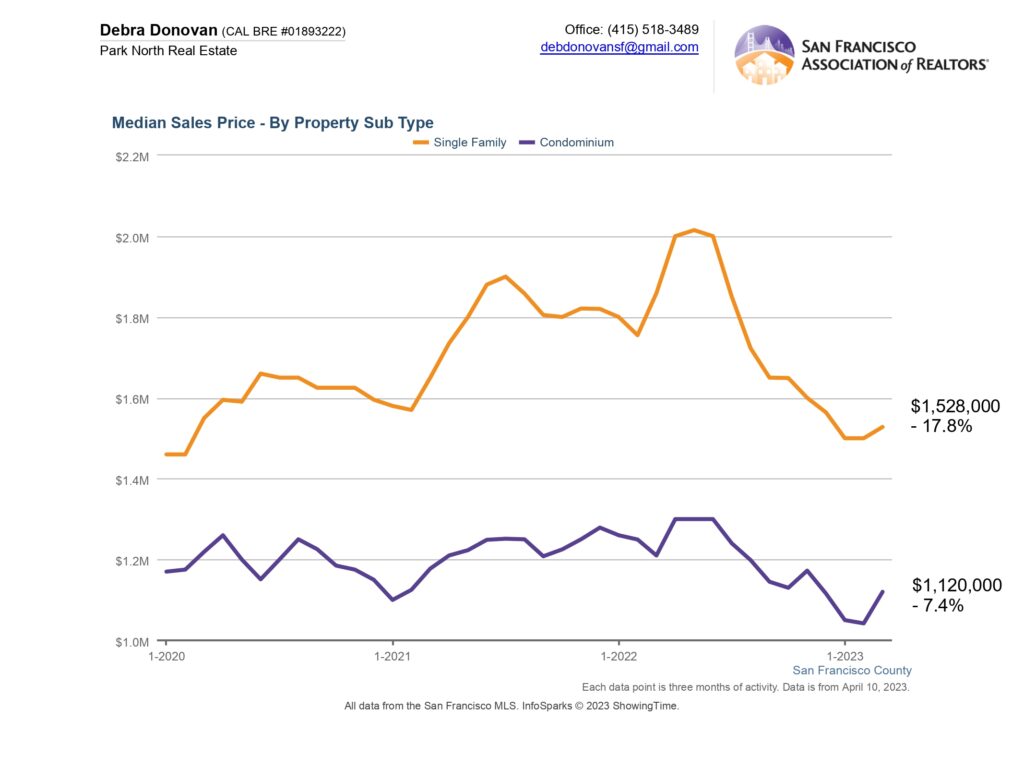
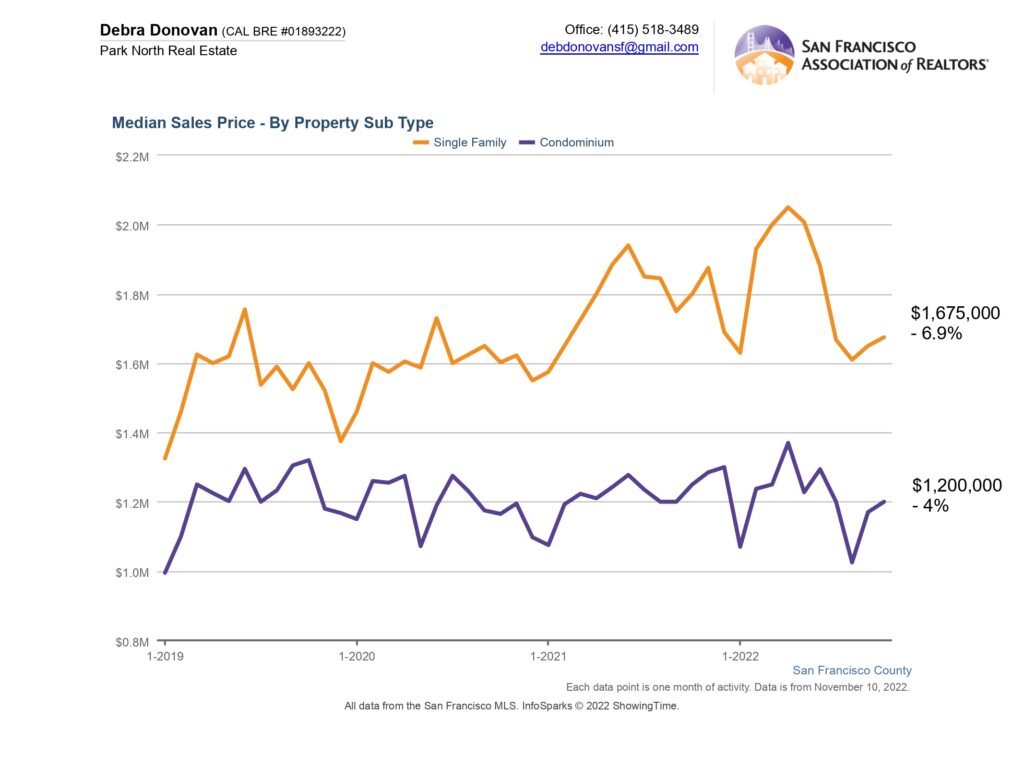
The median price for single family homes dropped almost 18% in Q1 2023 when compared to the same quarter 2022. Condo prices were off over 7% compared to last year.
New Listings:

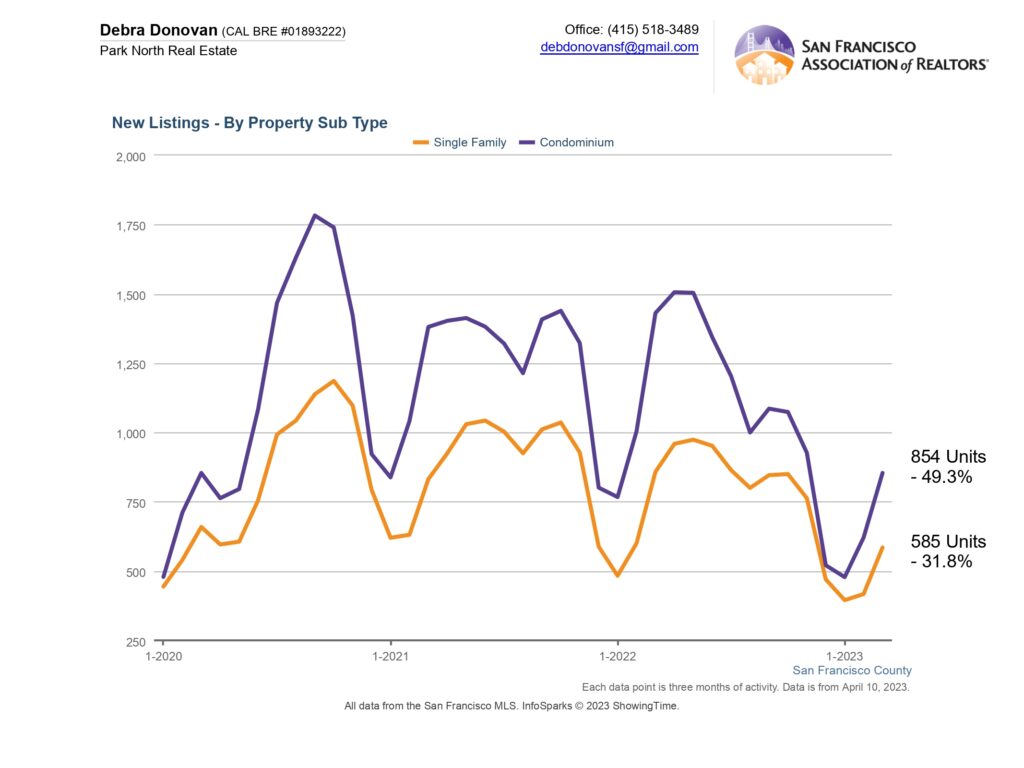
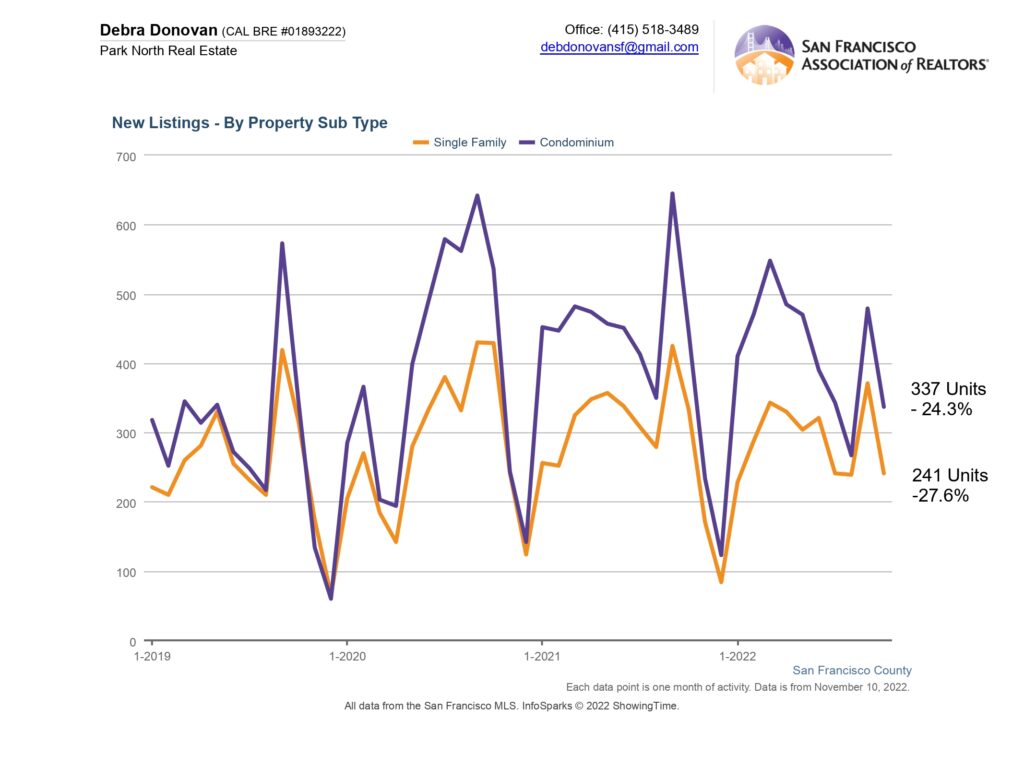
New listings were down significantly for both single family homes and condos. Single family home listings were down almost 32% while new condo listings were down almost 50%. Many who have bought or refinanced for incredibly low interest rates are not as motivated to sell if they don’t have to, leaving a dearth of new properties.
Sold Listings:

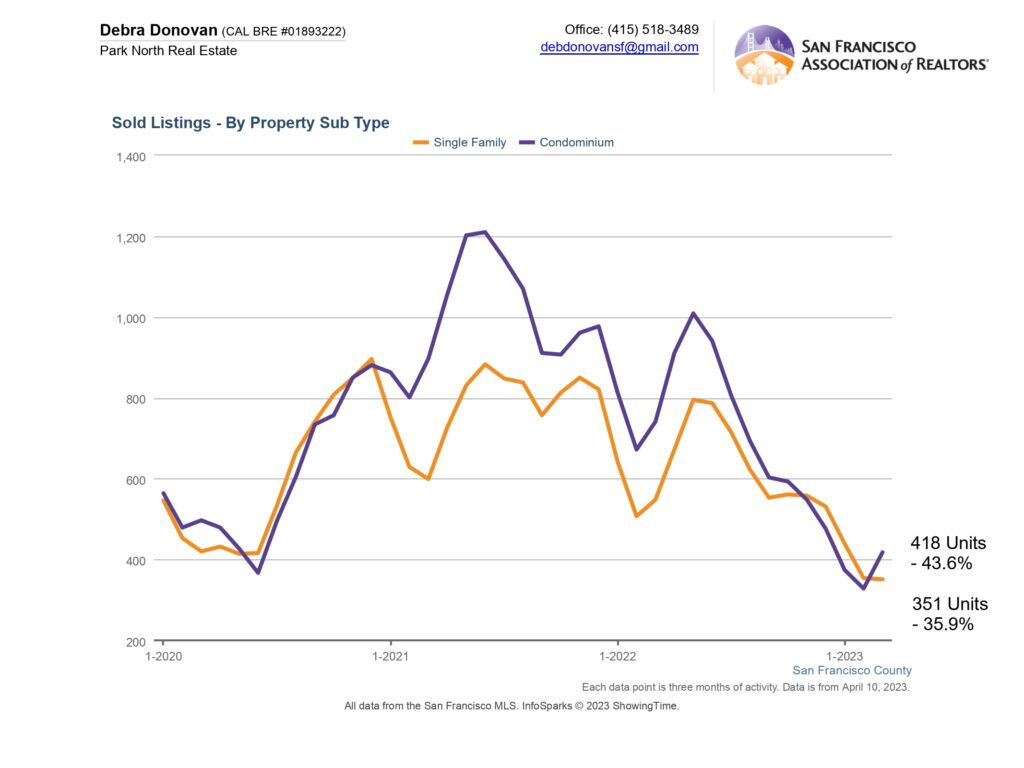
The number of listings that sold also decreased in Q1 2023 vs. Q1 2022. Partly this is due to fewer homes on the market, but it’s also because January and February were rainy and slow so homes stayed on the market longer.
Percentage of Properties Sold Over List Price:

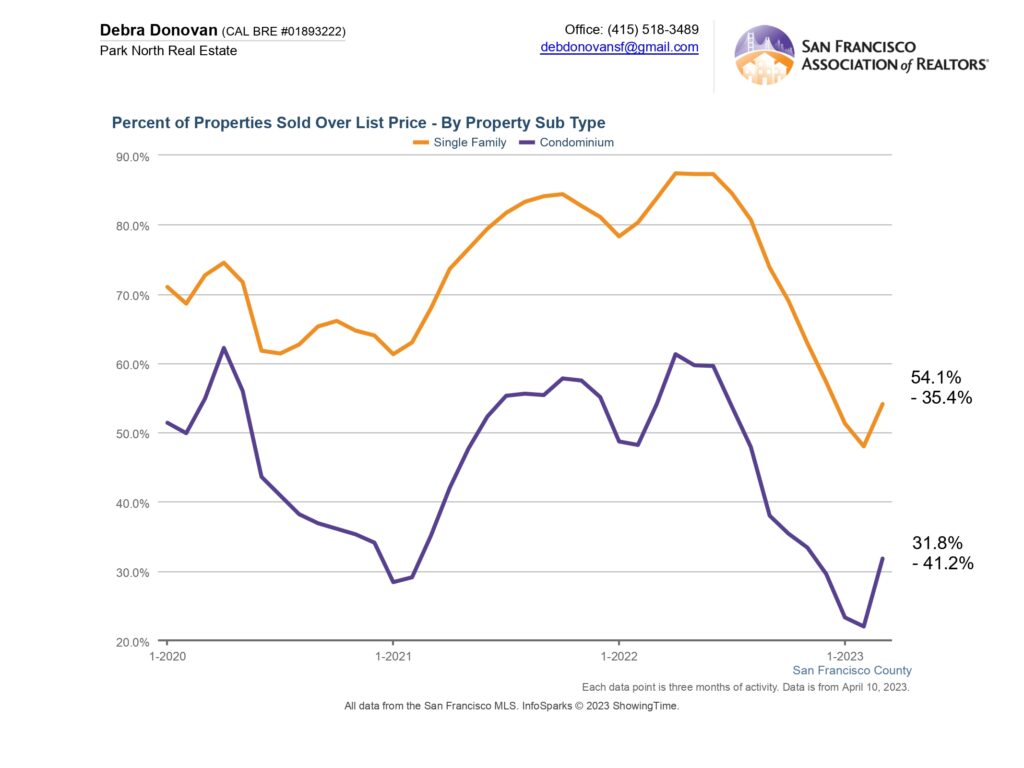
During slow Q1 fewer buyers meant fewer competitive offers and thus, fewer properties selling over their list price. Almost 55% of single family homes sold for over their asking price,  down over 35% compared to the same quarter last year. About 32% of condos sold for more than their list price, down 41% compared to Q1 2022.
Average Percentage of List Price Received:

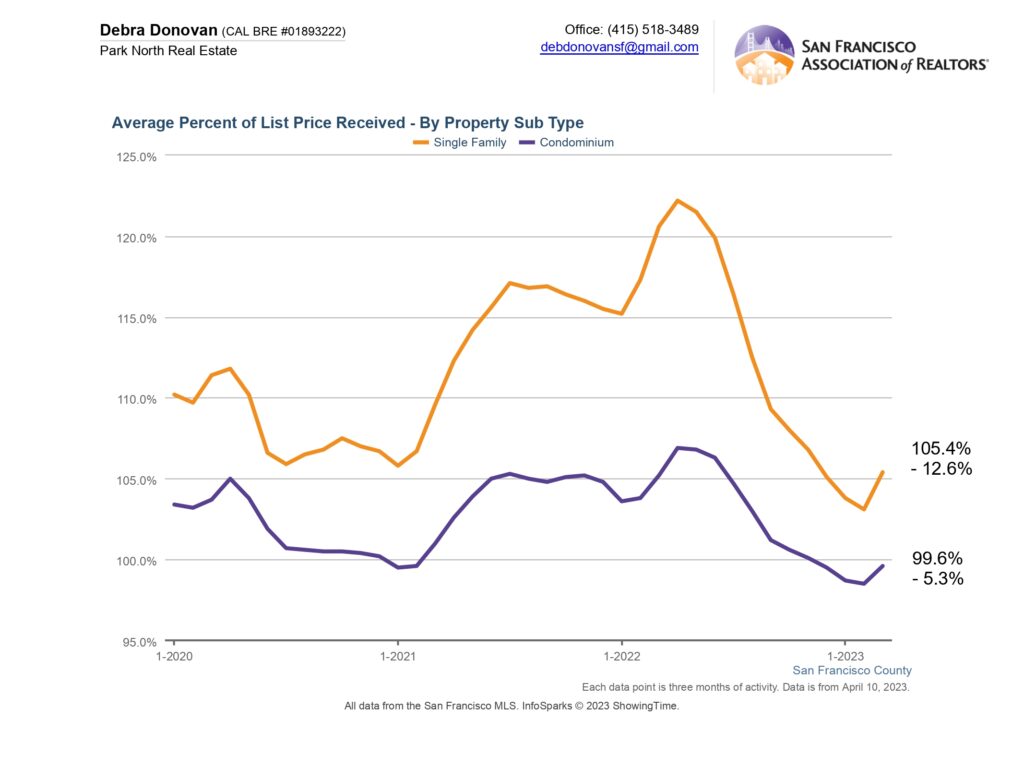
Single family homes sold for an average of 105.4% of list price, down 12.6% compared to over 120% in Q1 2022. Condos sold for an average of 99.6%, or just under list price, in the first quarter. This was down over 5% compared to the same quarter last year.
Months Supply of Inventory:

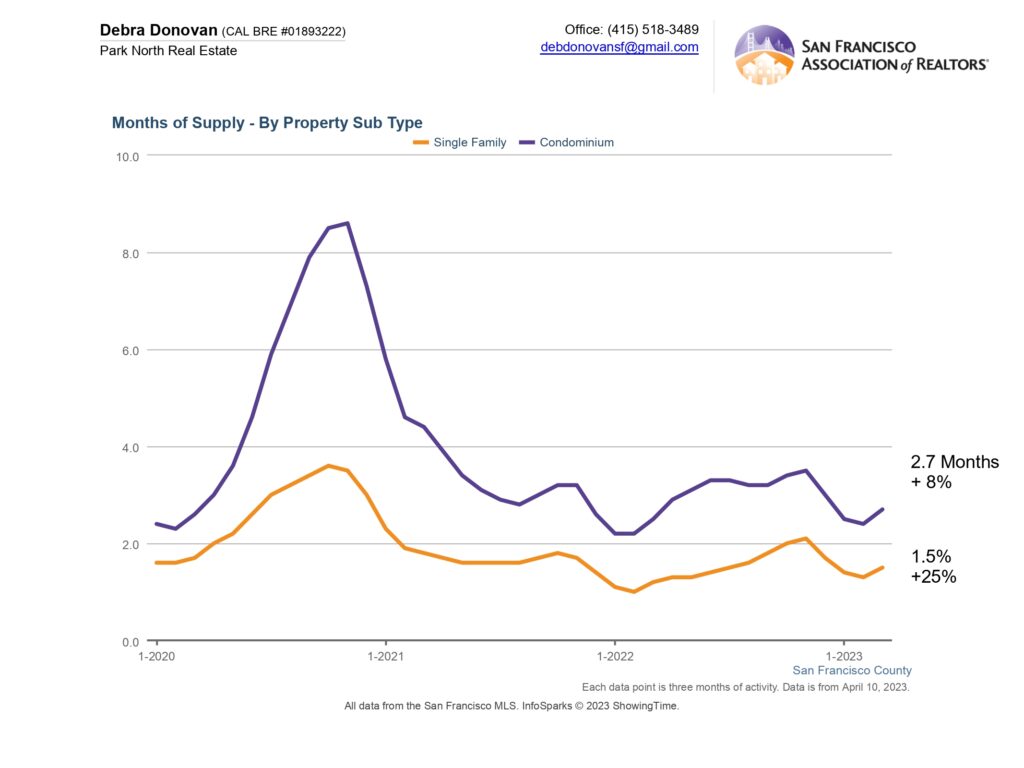
Month’s supply of inventory, or MSI, measures how quickly homes are selling through in the current market. An MSI of 5 months or less is usually considered a seller’s market, and 6+ months  of inventory indicates a buyer’s market. In Q1 2023 single family homes had an MSI or about 1.5 months, still a seller’s market and yet up 25% compared to the same quarter last year. Condos had 2.7 months of inventory, up 8% compared to last year but still in seller’s market territory.
Average Days on Market:

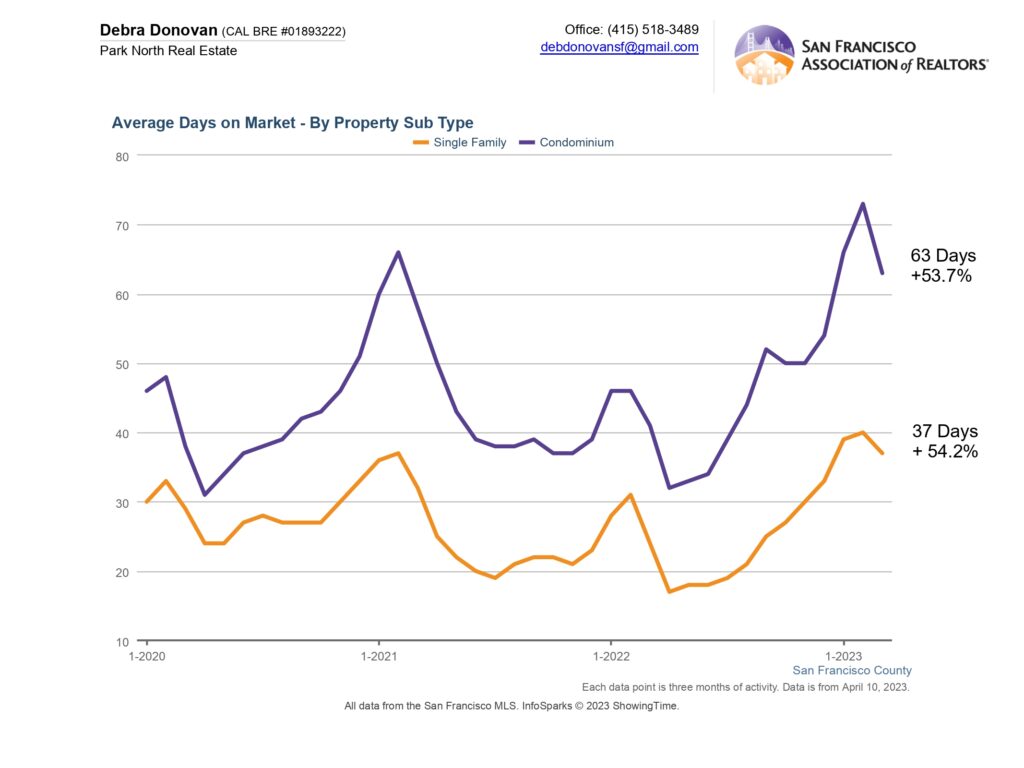
Single family homes spent an average of 37 days on the market before accepting an offer last quarter, up over 54% compared to the same quarter last year. Condos spent an average of 63 days on the market, also up about 54% compared to Q1 2022.
The fine print: All information deemed reliable but not guaranteed or warranted. Data comes from the MLS so does not include off-market and most new construction condo sales. The Bay Area real estate market is dynamic so statistics can change on a daily basis. These statistics are meant to be a snapshot of the day and time they were pulled.
Real Estate Agent with Park North Real Estate CA DRE# 01893222

Selling Your Home in Today’s Market

San Francisco Real Estate

After more than a decade of a strong seller’s market, the San Francisco Bay area real estate market has shifted. Inflation and the rising interest rates meant to combat it has taken a toll with some buyers, and as a result sellers.

One might think it’s all doom and gloom, but one would be wrong. In spite of all of the bad press, buyers are still buying and homes are still closing. But now more than ever sellers need the steady and experienced hand of a licensed real estate agent to guide you through the process. The game has changed a bit. Here are 3 tips for selling your home in this market. I call them the three P’s.

Preparation: Buyers can afford to be a little more picky now. Homes that are clean and well-presented are selling faster than those that have an imperfection or two. So making sure your house shines will bring you more interest and a better return. Staging, fresh paint, curb appeal and even just simple repairs can make all the difference in how quickly, and for how much, your home gets sold.

Price: Proper pricing is also paramount. The market has shifted and what your neighbor down the street sold him home for last Spring is not necessarily in line with the current market. Overpricing your home based on the past could negatively affect the interest in the property, and your final sale price. Also your pricing strategy may differ based on current competition, condition of your home, and your own personal financial goals. Be realistic with your pricing strategy.

Patience: The days of homes selling within hours of coming on the market with multiple offers are mostly gone. In a more balanced market where buyers have options, homes may be on the market for a little bit longer. But if you have prepared your home and priced it properly you stand a much better chance of selling quickly.

Last, don’t feel hopeless and like you missed the boat. Trying to time the market is a fool’s errand and the right time for you to sell is when you’re ready. Luckily, we live in a geographical area that will always be a desirable place to live.

If you’re thinking of selling in the coming year I can help you to get the best possible price and terms for your home. Reach out and I can share my marketing and negotiation strategy with  you.

Real Estate Agent with Park North Real Estate CA DRE# 01893222

October 2022 San Francisco Real Estate Market

San Francisco Real Estate

From what you’re seeing and hearing in the media, you might think the San Francisco real estate market is in a free fall. Don’t be fooled. What is happening is a calming of the market, not necessarily a bad thing. Median prices were down year-over-year to about the same as what we saw in October, 2020. While interest rates are up, resulting in more of a balanced market than what we’ve  seen in over a decade, buyers are still buying and there are still fewer sellers selling. As a result, it’s still a seller’s market though for many properties the heyday of multiple offers has passed for now and some are staying on the market longer. Still, homes that are well  prepped for sale and properly priced are still seeing swift sales and some are still getting multiple offers.

So if you’re thinking of buying, now’s the time to jump into the market before interest rates rise again. You’ll have less competition than you’ve had in the past.

If you’re thinking of selling, today’s market means preparation and pricing are everything. And of course, patience.

Here are the statistics below,

Median Price:

The price for a single family home fell about 7% in October compared to October 2021, making it about the same as the median price in 2020. Condos were also down 4% year over year.

New Listings:

New listing were again down year over year. New single family home listings were down more than 27% while new condo listings were down almost 25%

Active Listings:
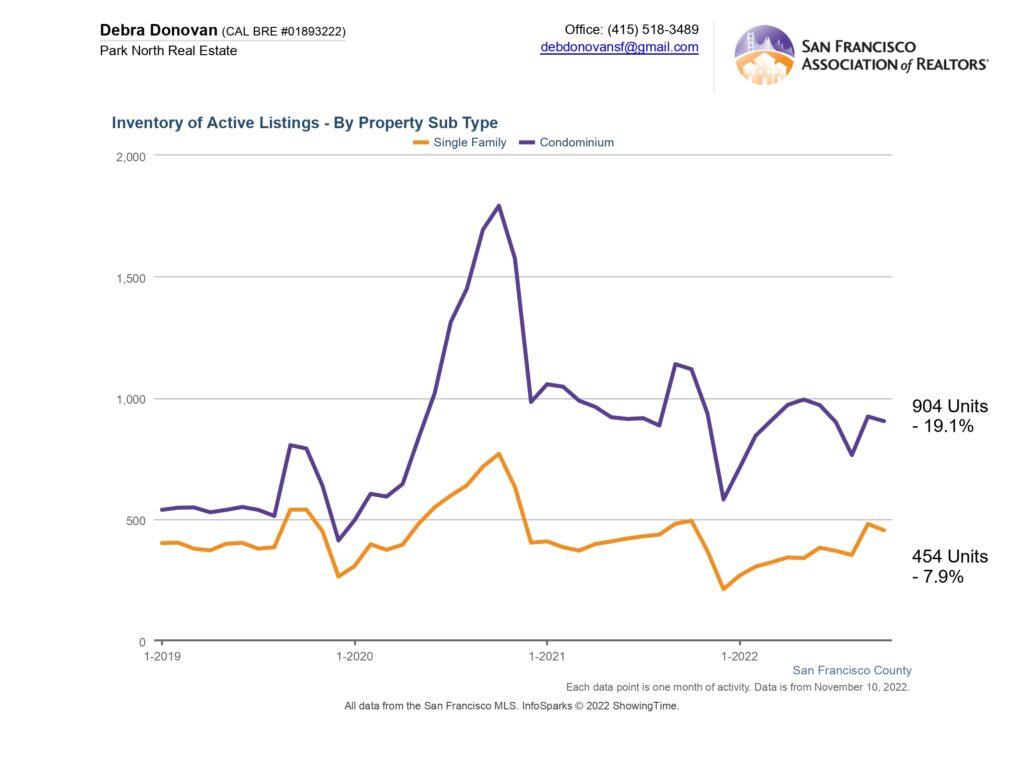
Like new listings, active listings -those still on the market at the end of them month – were also down though perhaps not as low as in the past. Active single family home listings were down 8% while active condo listings were down 19%.

So

Percentage of Properties Sold Over List Price:

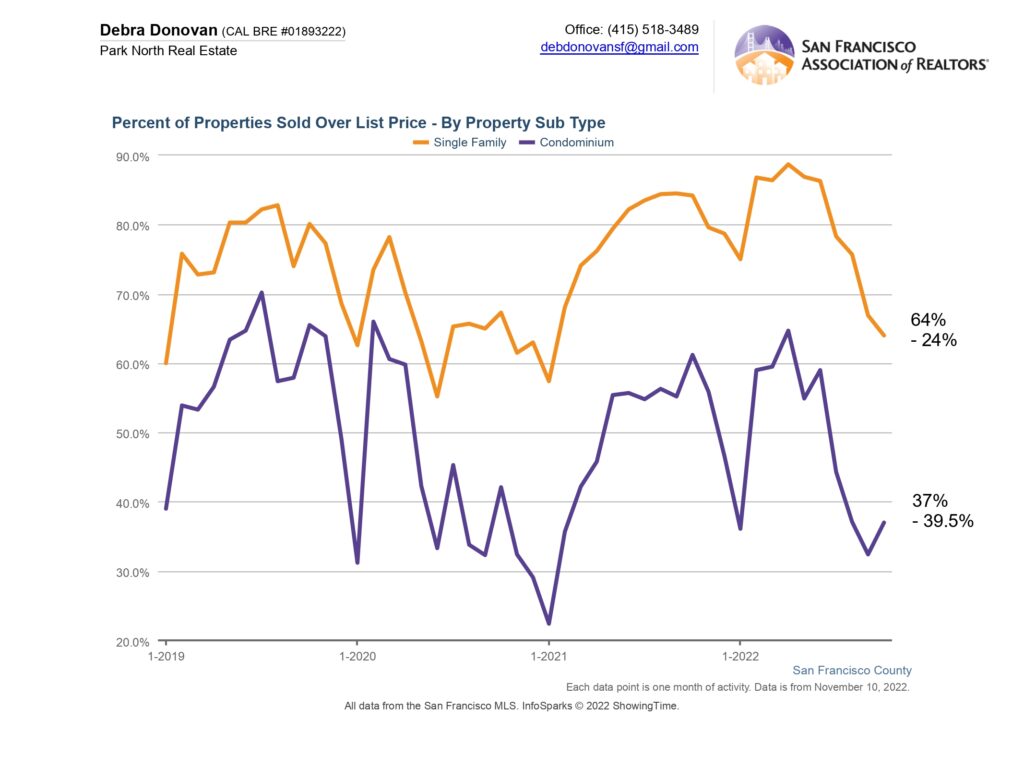
Fewer San Francisco homes are selling for over their asking price. As properties sit on the market a bit longer and competitive multiple offers are not as rife, more homes are selling at or close to their offer price. Though not all. Almost two-thirds of single family homes sold for over their list price in October, down 24% compared to October 2021. Only 37% of condos sold over their list price, down almost 40% year-over-year.

Average Percentage of List Price Received:

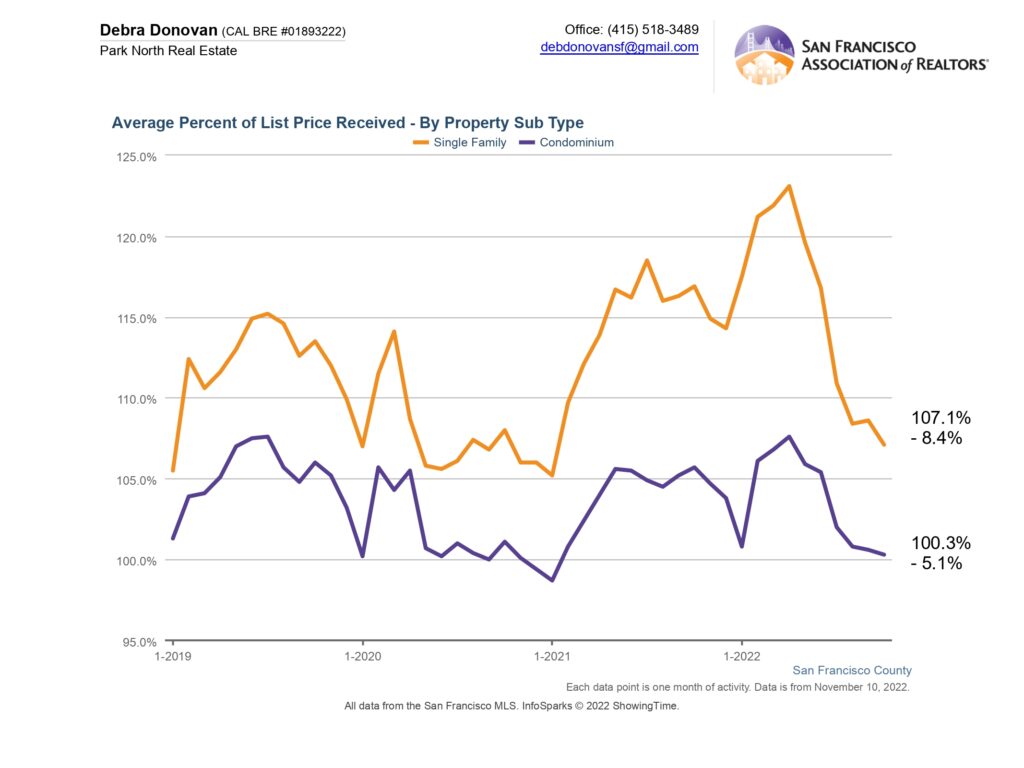
Just as the percentage of homes overall that sold over their list price decreased, so too did the average percent of list price received decrease. Single family homes sold for 107% of their list price in October, down 8% year over year. Condos sold on average for just about their list price, 100.3%, down 5% compared to October 2021.

Months Supply of Inventory:

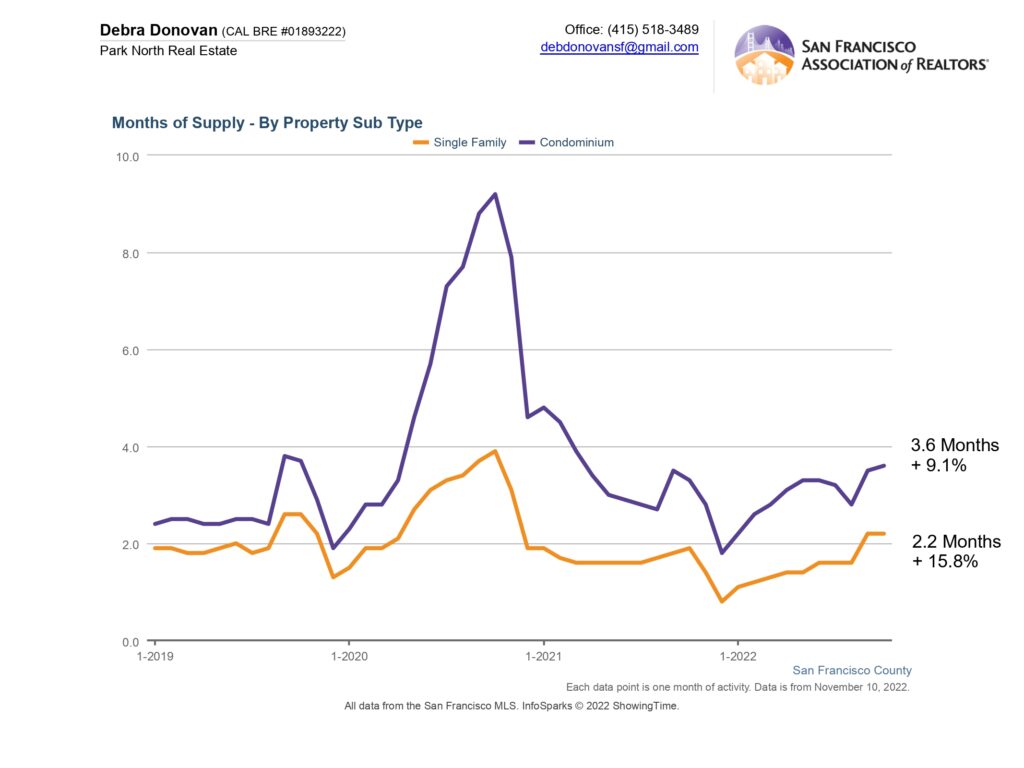
MSI for both single family homes and condos crept up in October. Single family homes had 2.2 months of inventory in October, up 16% year over year. Condos had 3.6 months of inventory, up 9%. To put this in perspective, last October the stats were 1.9 months and 3.3 months respectively, so while the change seems significant it really isn’t.

Average Days on Market:

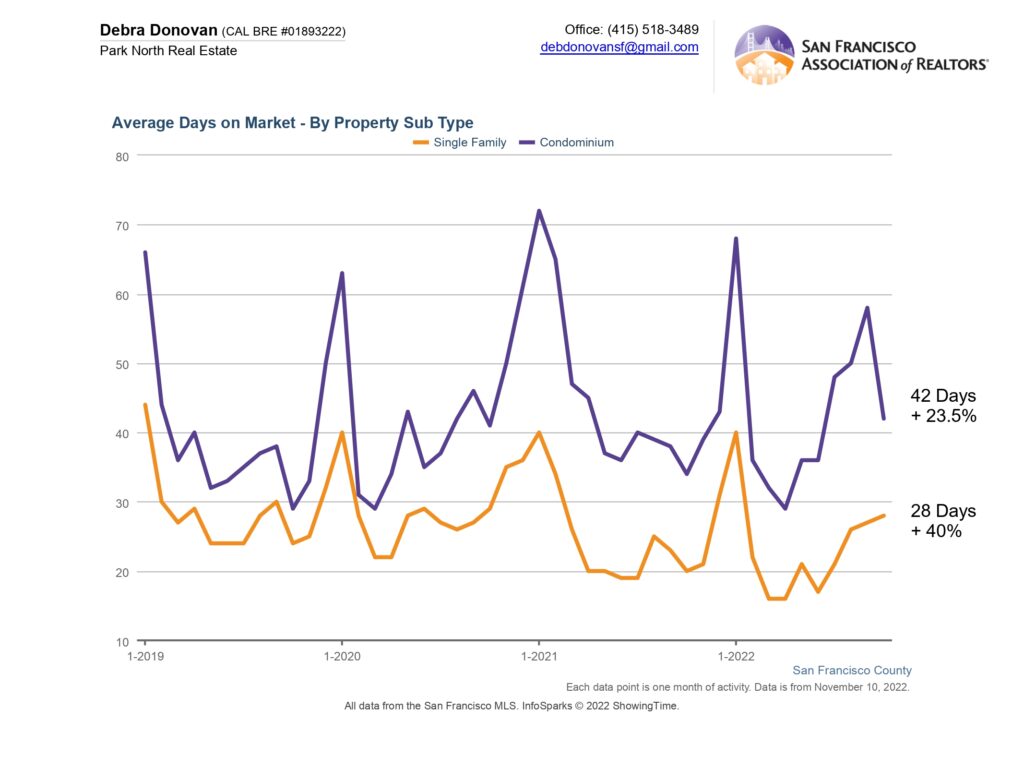
Like months supply of inventory, the average days on market that a property was on market before accepting an offer also increased. Single family homes spent an average of 28 days on the market, up 40% compared to October 2021. Condos spent 42 days on the market on average, up 24% year over year. Like median sales price, these statistics were also about the same as October of 2020.

The fine print: All information deemed reliable but not guaranteed or warranted. Data comes from the MLS so does not include off-market and most new construction condo sales. The Bay Area real estate market is dynamic so statistics can change on a daily basis. These statistics are meant to be a snapshot of the day and time they were pulled.


Real Estate Agent with Park North Real Estate CA DRE# 01893222

Daly City Q3 2022 Real Estate Market Update

San Francisco Real Estate

The Bay Area real estate market, including Daly City, shifted in the third quarter of this year. Rising interest rates and inflation, combined with a volatile stock market all contributed to a slowing in buyer purchase power and demand.

As a result, median sales prices fell even as inventory remained in a deficit. Homes took a bit longer to sell and there were fewer bidding wars. However the market still stayed in sellers’ market territory.


Median Sales Price:

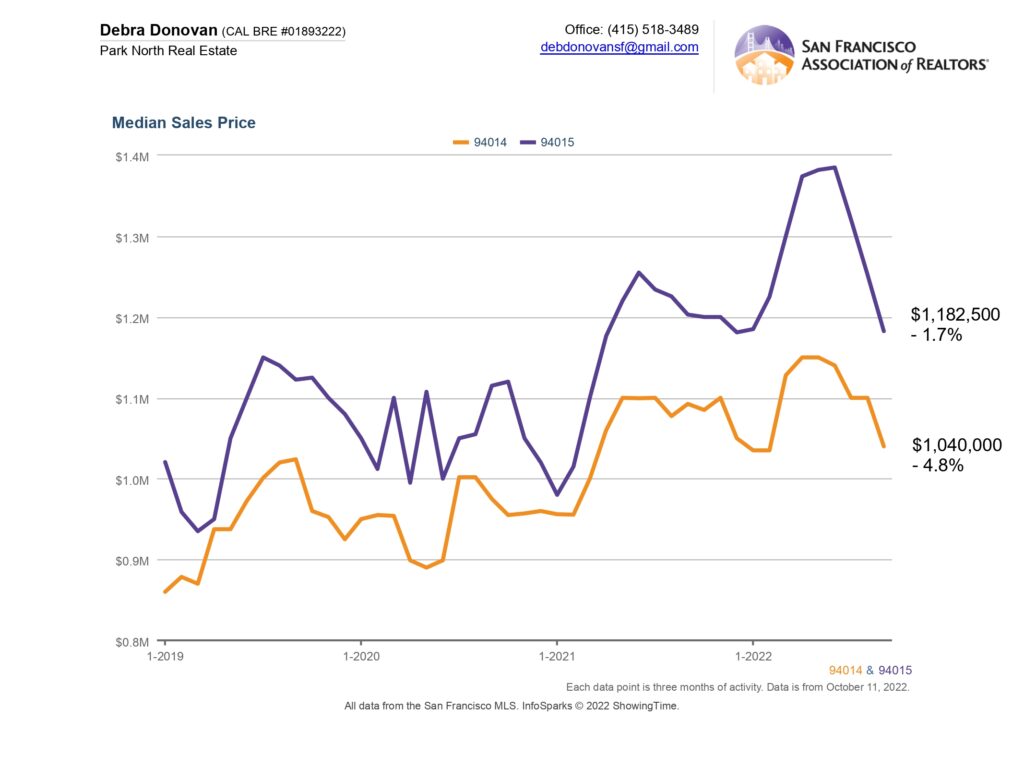
The median sales price for homes in zip code 94014 fell about 5% to $1,040,000 in Q3. Homes in zip code 94015 fell almost 2% to $1,182,500.

New Listings:

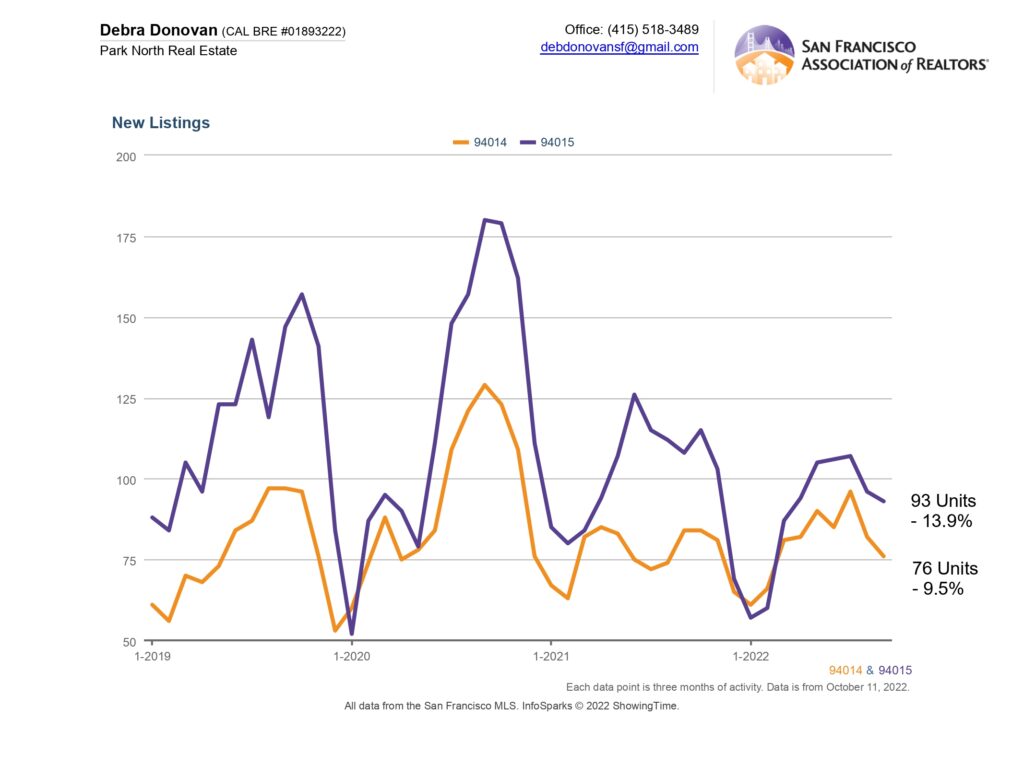
In addition to decreasing prices, there were also fewer new properties for sale in Daly City in Q3. Zip code 94014 had just 76 new listings over the quarter, down almost 10% compared to Q3 2021. Zip code 94015 had 93 new listings, down 14%.


 Sold Listings:

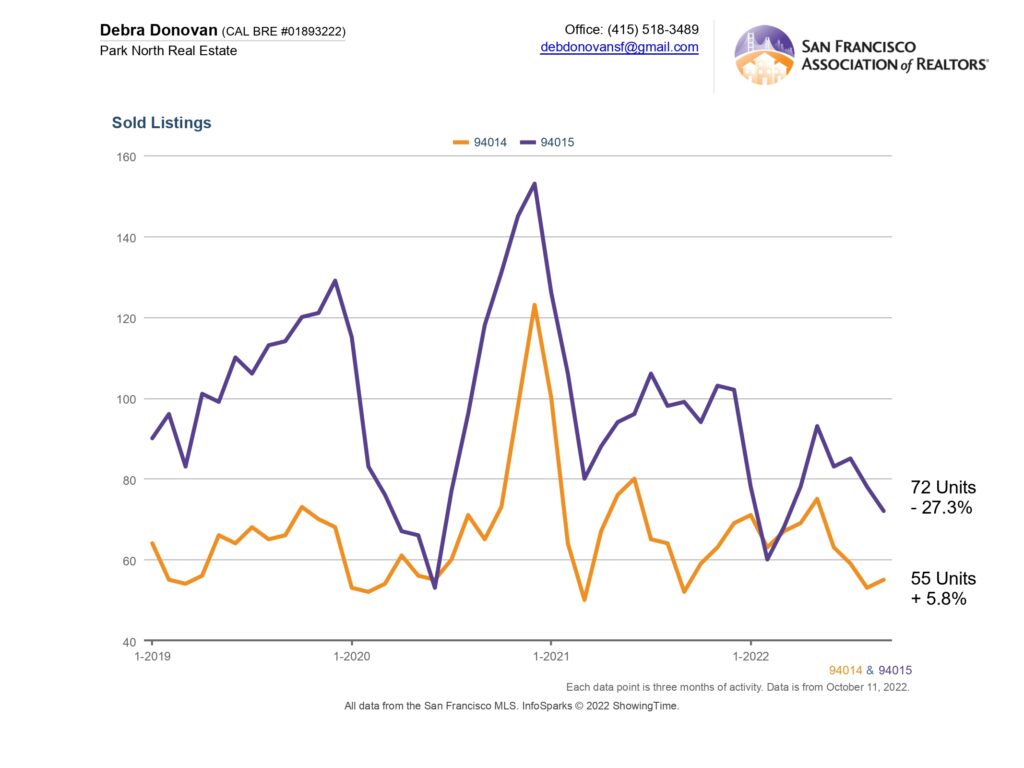
There was a dichotomy between sold listings throughout Daly City. Zip code 94014 saw sold listings increase by almost 6% while zip code 94015 saw a decrease of 27% in sold listings quarter-over-quarter.

Percentage of Properties that Sold Over List Price:
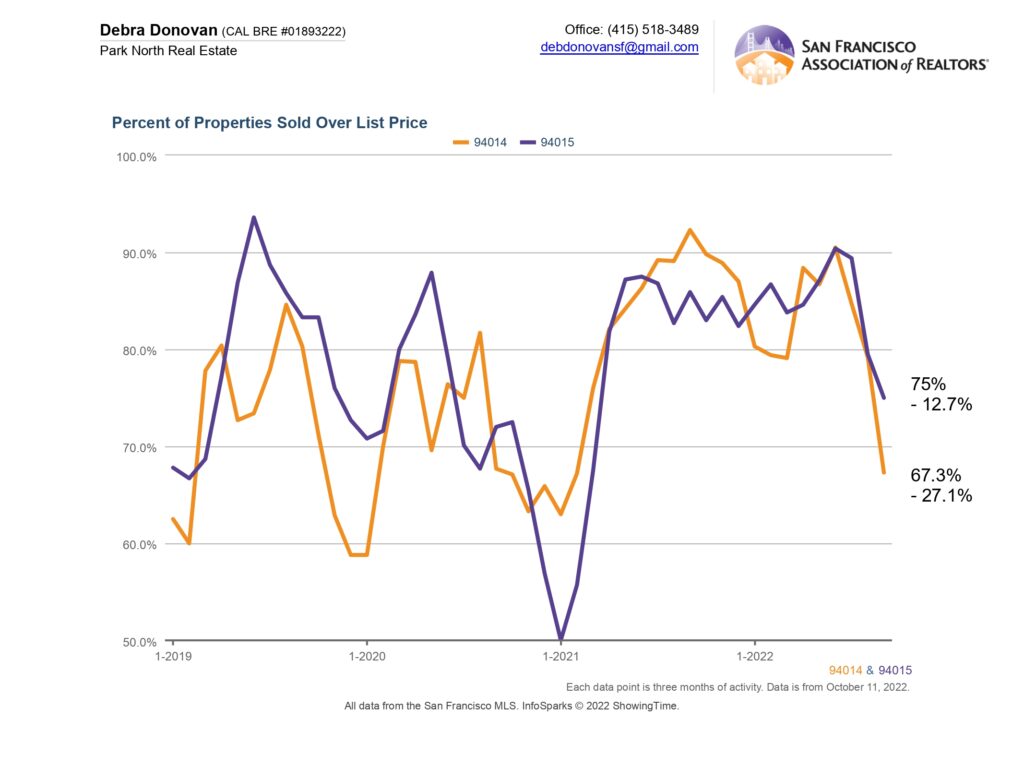
As buyer demand declined so did the number of bidding wars. The overall percentage of properties that sold above their list price decreased. About two-thirds of homes in zip code 94014 sold for more than the list price in Q3, down 27% compared to Q3 2021. Three-quarters of homes in zip code 94015 sold above list price, down 13% for the quarter.

Average Percentage of List Price Received:

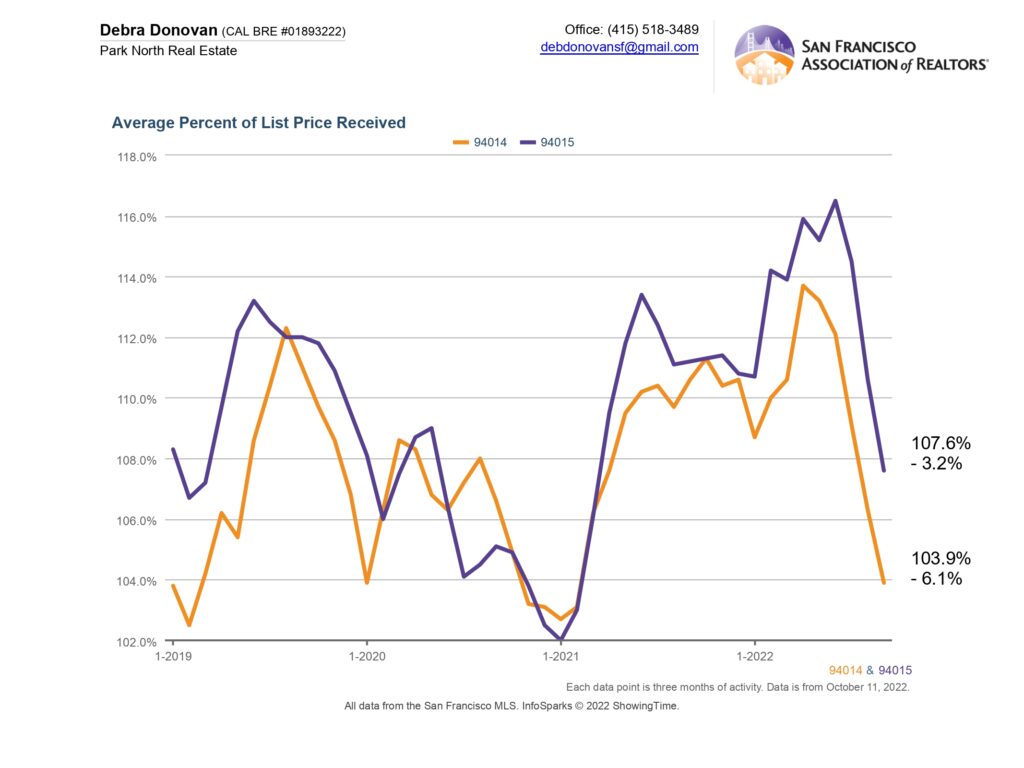
As buyers held back from extreme bidding wars, the average percent of list price that homes received also decreased. Homes in zip code 94014 sold for an average of 104% of their list price in Q3, down 6% compared to the same quarter last year. Homes in zip code 94015 sold for an average of 107% of their list price, down a little more than 3%.

Average Days on Market:

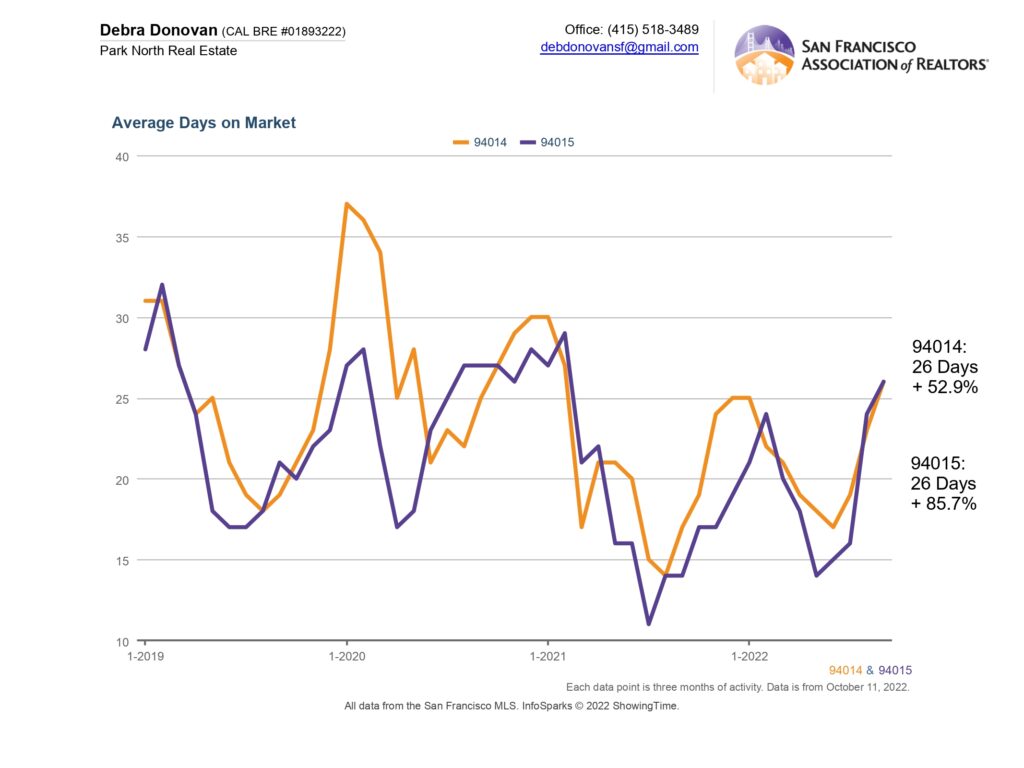
The average days on market for homes in zip codes 94014 and 94015 increased to 26 days on the market before accepting an offer. In Q3 of 2021 homes were on the market for an average of 17 and 14 days respectively. So while 26 days may seem quick to many parts of the country, it’s an increase for here in the Bay Area markets.

Months Supply of Inventory:

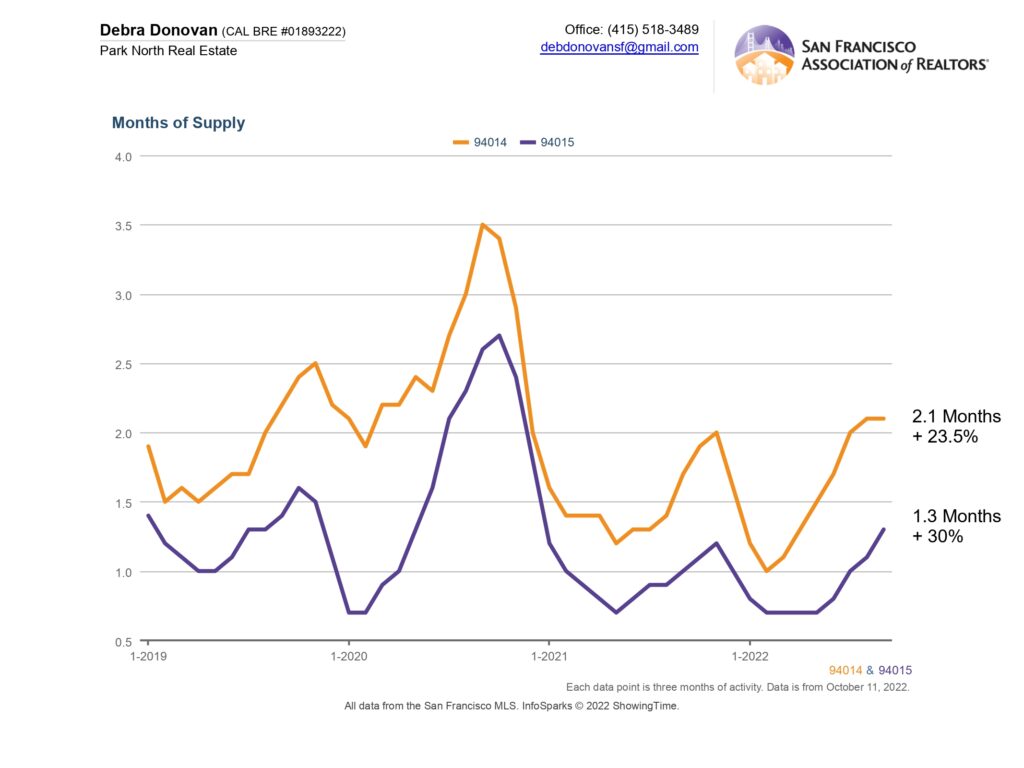
For all of the doom and gloom we’re hearing about the market, it continues to be a sellers’ market based on the absorption rate of properties, called Months Supply of Inventory or MSI. Zip code 94014 had 2.1 months of inventory, while zip code 94015 had just 1.3 months. Both were an increase compared to last year’s Q3, but a more balanced market would show 6 or so months of inventory.


The fine print: All information deemed reliable but not guaranteed or warranted. Data comes from the MLS so does not include off-market and most new construction condo sales. The Bay Area real estate market is dynamic so statistics can change on a daily basis. These statistics are meant to be a snapshot of the day and time they were pulled.


Real Estate Agent with Park North Real Estate CA DRE# 01893222

Q3 2022 San Francisco Real Estate Market

San Francisco Real Estate

Rising interest rates and a volatile stock market shifted the San Francisco real estate market in the third quarter. Buyer demand waned as their spending power fell while interest rates rose. Seasonality may also have played a role because the summer months are typically slow.

Meanwhile home sales slowed a bit and properties took longer on the market to get into contract compared to the same quarter last year. Even so, we are still in sellers’ market territory here in San Francisco.

Median Price:

The median price for a single family home slipped almost 9%  percent in the 3rd quarter compared to the same quarter last year. Condo prices dropped 5% to $1,147,500.

New Listings:

New listings for single family homes and condos were also down for the quarter. There were fewer than 850 new single family home listings in Q3, down 16%. Fewer than 1100 condos came on the market in Q3, down 22.7%.

Sold Listings:

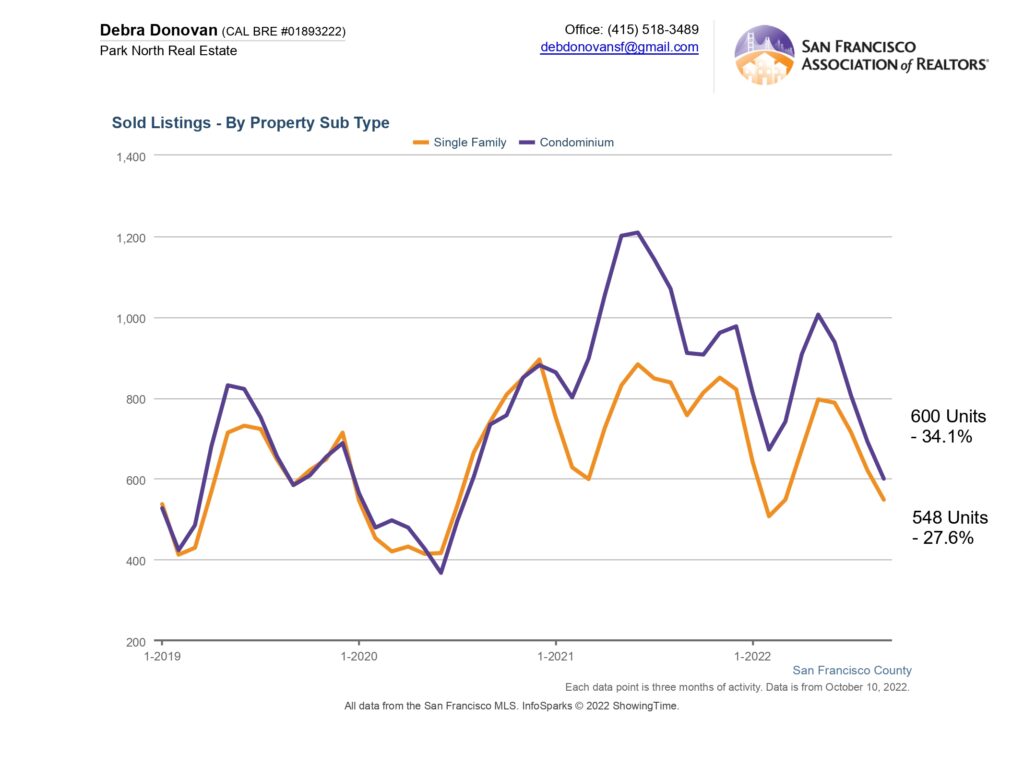
Sold listings decreased for both single family homes and condos. Single family home sales were down about 28% while condos sales were down 34%.

Percentage of Properties Sold Over List Price:

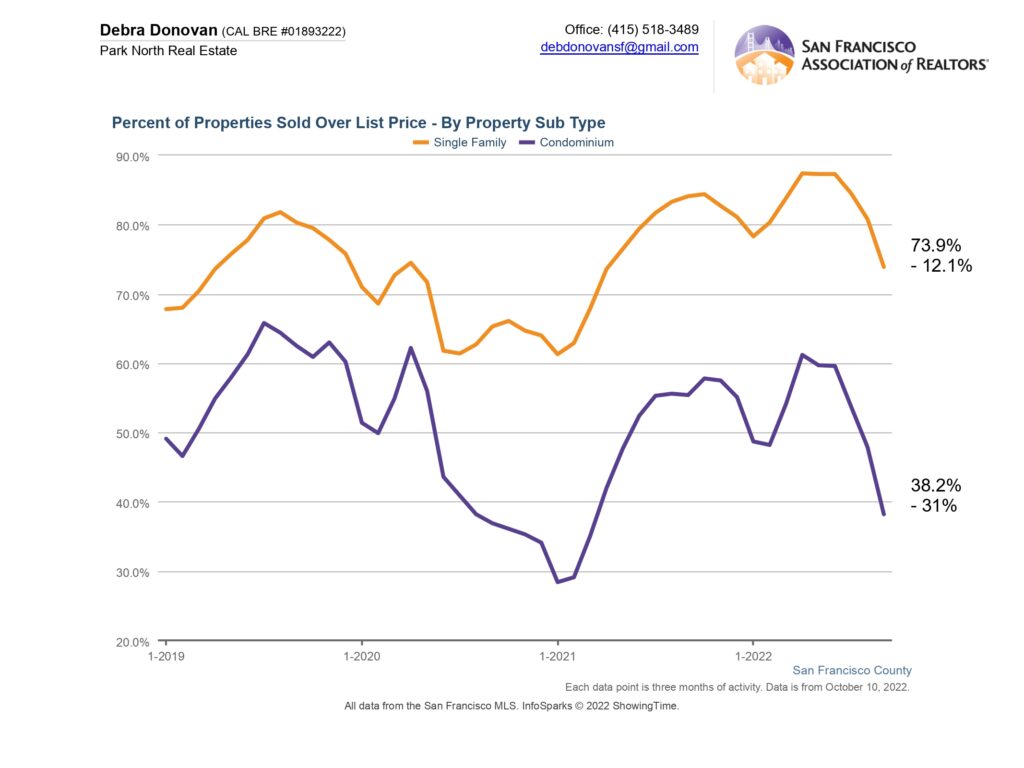
As demand slows and home options for buyers pick up, we are seeing fewer bidding wars for properties, resulting in the percentage of properties selling over their list price to decrease. Just 74% of single family homes sold for over their asking price, down 12% compared to the 3rd quarter 2021. Just 38% of condos sold for over their list price, down over 30%. Seasonality can play a role in this as the summer is typically quieter.

Average Percentage of List Price Received:

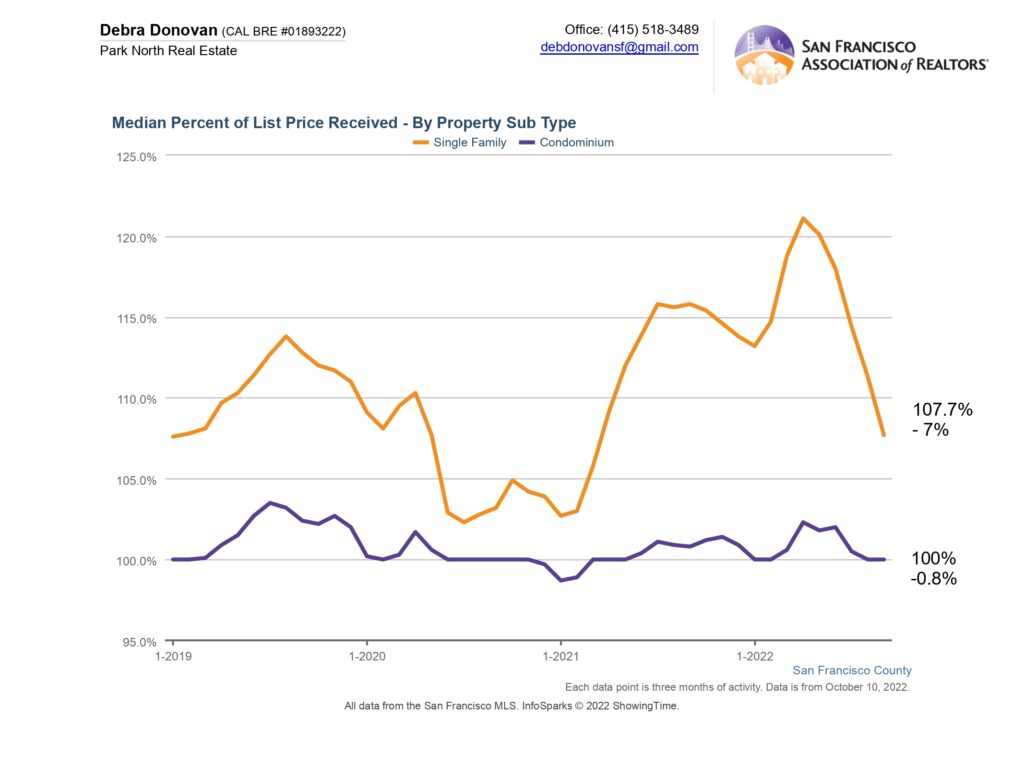
The average percentage of list price received in the third quarter for single family homes was 107.7%, down 7% compared to last year’s third quarter. Condos sold on average 100% of their list price, down less than 1% of what they sold for in 2021.

Average Days on Market:

Another indication of the slowing market is homes staying on market longer before accepting an offer. Single family homes spent an average of 25 days on the market in the third quarter, up almost 14% compared to Q3 2021. Condos averaged 52 days on the market, up a third compared to last year.

Months Supply of Inventory:

While the months supply of inventory, which illustrates how long it would take for the existing homes to sell through based on current demand, has increased for both single family homes and condos, it remained in seller market territory in the 3rd quarter.

The fine print: All information deemed reliable but not guaranteed or warranted. Data comes from the MLS so does not include off-market and most new construction condo sales. The Bay Area real estate market is dynamic so statistics can change on a daily basis. These statistics are meant to be a snapshot of the day and time they were pulled.


Real Estate Agent with Park North Real Estate CA DRE# 01893222

Daly City Real Estate Market Update – Summer 2022

San Francisco Real Estate

Unless you’ve been living under a rock, you’ve probably heard the alarm bells that the real estate market is cooling. Rising interest rates, falling stock prices and Bay Area companies not yet returning to the office have all contributed to a lessening of demand for local real estate. This, in turn, has caused prices to cool, inventory to stay on the market longer, and (great news for buyers)…less competition.

Daly City, too, is starting to experience this cooling. This summer, prices were only up minimally year-over-year, while sold listings and overbids were down slightly. Some properties are sitting on the market for longer than we are accustomed to. However, it’s perhaps not yet quite as dire as the media is making it out to be. Yes, prices are coming down and demand is slipping. But the majority of homes are still receiving over-asking offers and inventory is still low, staying in solid seller’s market territory.

Below are the market statistics for Daly City for Summer 2022 compared to Summer 2021.This includes June, July and August. A couple of things to keep in mind when reading this: First, due to the longer selling cycle of real estate, data for demand and prices are typically about 30 days behind. For example, properties that sold in June likely came onto the market in May when the market was more robust. Second, Daly City is a finite geographical area with a smaller sample size. So a shift of even 1-2 properties can make that seem a more significant percentage change than it really is.

If you have any questions regarding the Daly City real estate market, or if you’re thinking of buying or selling a home in Daly City, don’t hesitate to reach out. I’d be delighted to help you.

Median Sales Price:

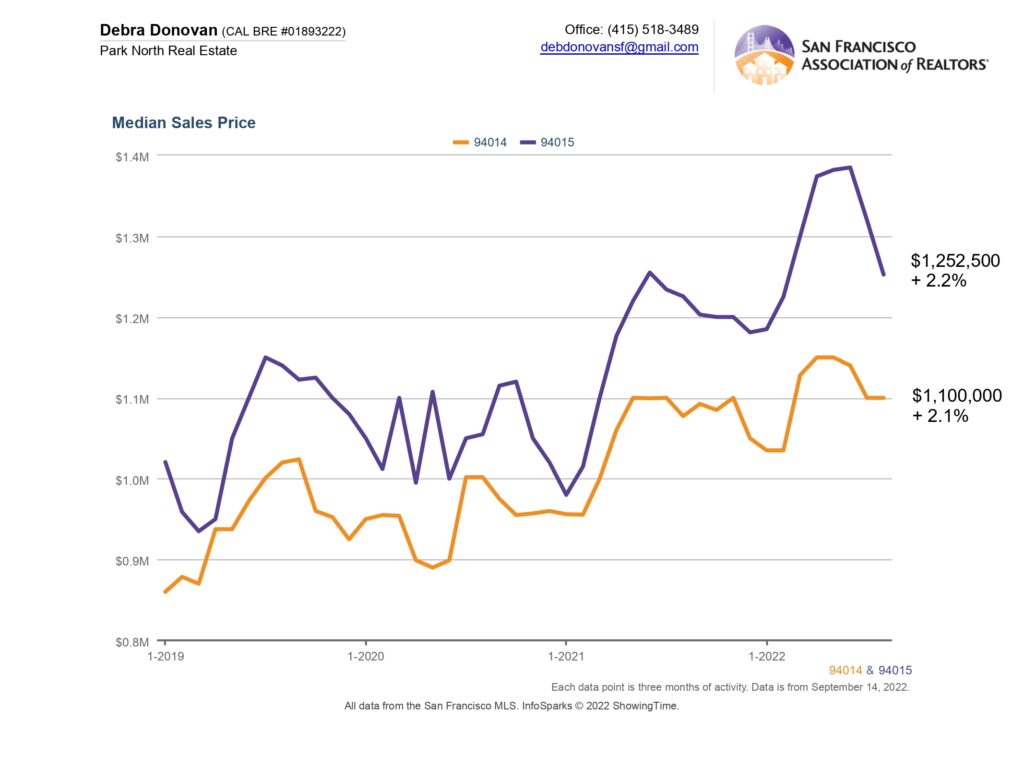
The median sales price for homes in zip code 94014 increased 2% year-over-year to $1,000,000. Zip code 94015 saw a 2.2% increase to $1,252,500.


New Listings:
There was a dichotomy between zip codes in the number of new listings that came on-market this summer. Zip code 94014 saw 82 new listings, an increase of over 10%,  while zip code 94015 new listings decreased 14% to 96 listings.

Sold Listings:

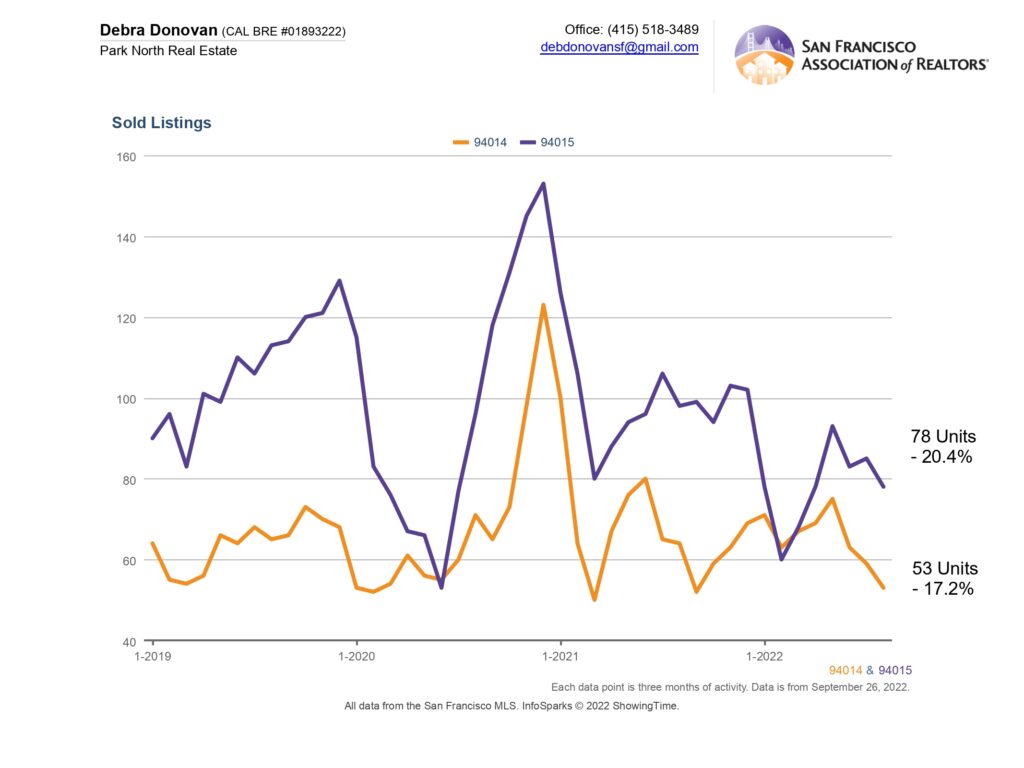
Both zip codes 94014 and zip code 94015 experienced a decreased number of homes that sold over the summer, a result of the market cooling we’ve been experiencing. Zip code 94014 sold 53 homes, a decrease of 17% while zip code 94015 sold 78 homes, down over 20%.

Percentage of Properties Sold Over List Price:

It stands to reason that with fewer sales there is less buyer competition and thus fewer homes selling over their list price. This is not across the board however. Very desirable homes are still selling quickly and well over their asking price. In fact, this is still the case for the majority of homes in Daly City. About 79% of homes in zip code 94014 sold for over their list price this summer, which was a decrease of 11% over last summer. Zip code 94015 also saw almost 80% of homes sold sell for over list price. That’s down almost 4% compared to summer 2021.

Average Percentage of List Price Received:

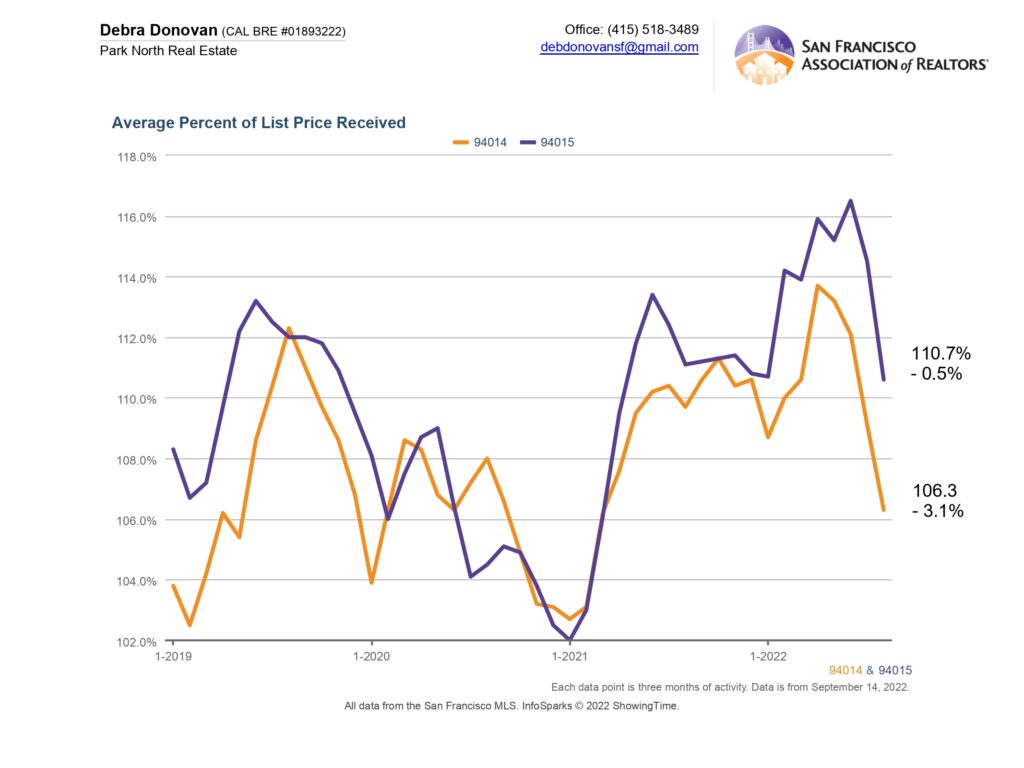
The average sales price for homes in Daly City also slipped this summer, though not markedly. The average percentage of list price received in zip code 94014 was 106%, down a little over 3%. Zip code 94015 homes sold on average 110.6% of their list price, down just .50% compared to last summer.

Months Supply of Inventory:

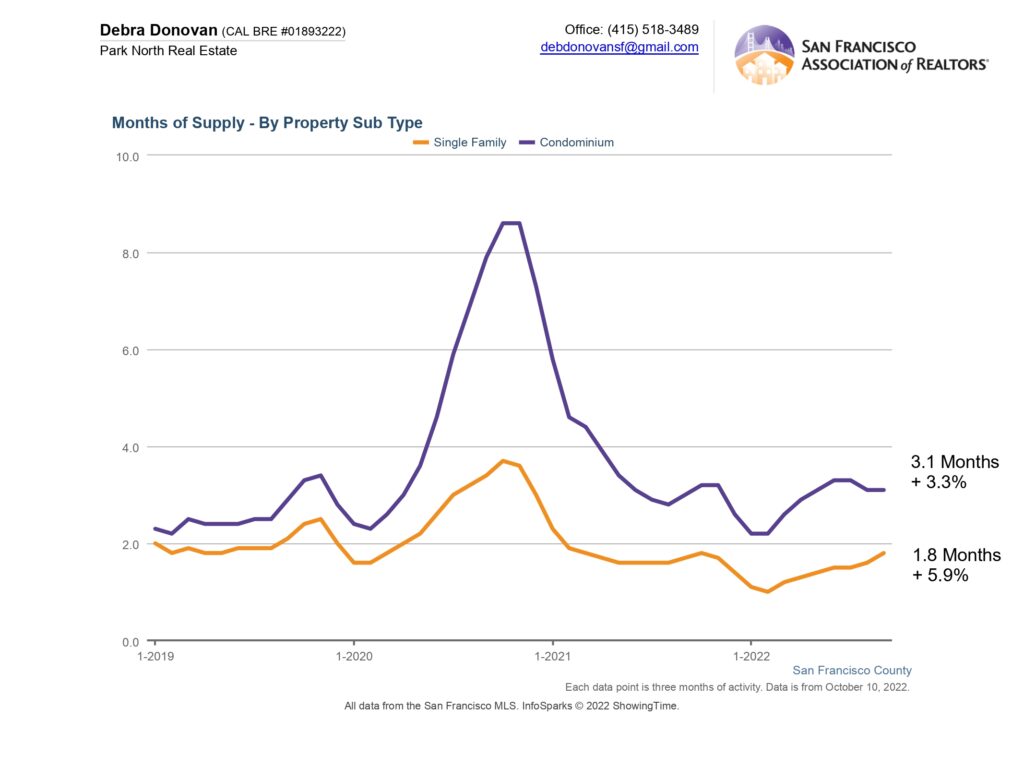
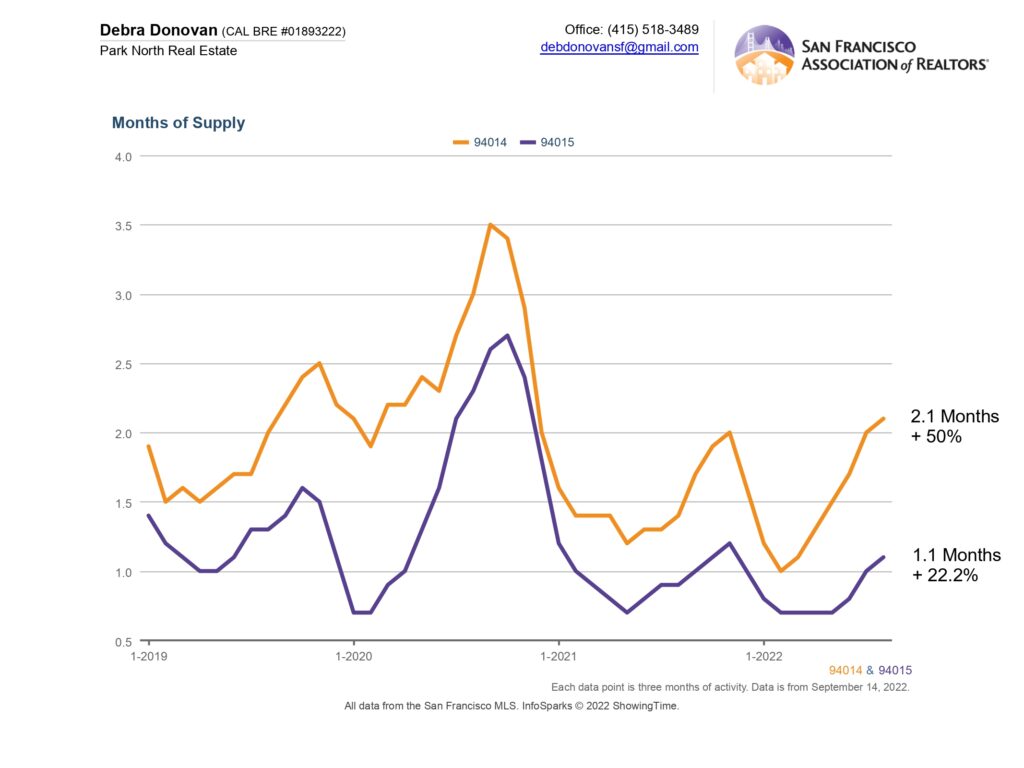
Months Supply of Inventory, or MSI, is an indication of how quickly homes are selling in a particular market. For many years Daly City has been a seller’s market, typically defined 5 months or less of inventory. A balanced market would be 6-8 months of inventory, while 9 or more months defines a buyer’s market. While MSI increased over the summer, Daly City continues to very much be a seller’s market. Zip code 94014 ended the summer with 2.1 months of inventory, up 50% compared to last summer. Zip code 94015 had 1.1 months of inventory, incredibly low but still up from summer 2021.

Average Days on Market:

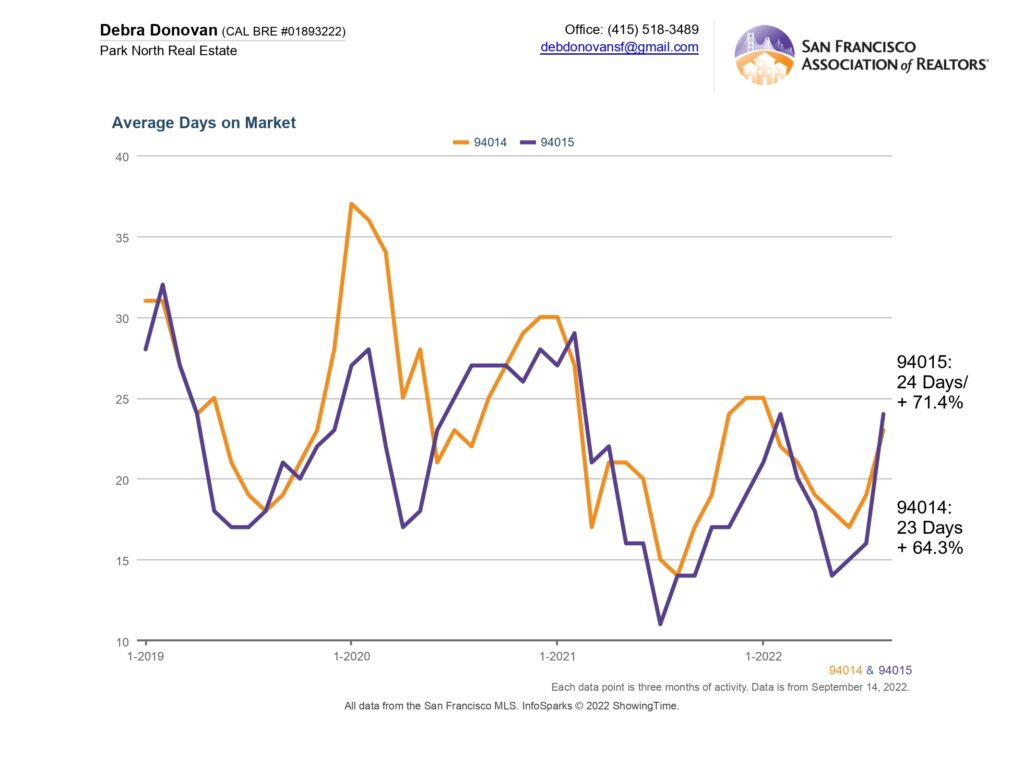
Days on market indicated the number of days a property remains on the market before accepting an offer. This summer, homes in zip code 94014 spent an average of 23 days on the market, an increase of over 64% compared to last summer. Homes in zip code 94015 spent an average of 24 days on market, up over 70% compared to summer 2021.

The fine print: All information deemed reliable but not guaranteed or warranted. Data comes from the MLS so does not include off-market and most new construction condo sales. The Bay Area real estate market is dynamic so statistics can change on a daily basis. These statistics are meant to be a snapshot of the day and time they were pulled.


Real Estate Agent with Park North Real Estate CA DRE# 01893222

September 2022 San Francisco Real Estate Market Update

San Francisco Real Estate

In August rising interest rates and falling stock prices, particularly in the tech sector, resulted in decreased demand and cooling home prices in the San Francisco real estate market. Fewer homes selling means fewer are selling for over their asking price (though many still do), causing some homes to stay on the market longer. While rising interest rates can knock some buyers out of the market due to affordability with higher rates, it offers an opportunity for buyers who are hoping for less competition. While it’s still a seller’s market we do appear to be moving a bit toward a more balanced market.

Prices typically rise in the spring and then stabilize in the summer, so it may be too soon to say just how much the market is cooling. Moving into September, though, we are already seeing an influx in inventory so most are predicting that the market cooling will continue.

Below are the market statistics for August 2022.

Median Sales Price:

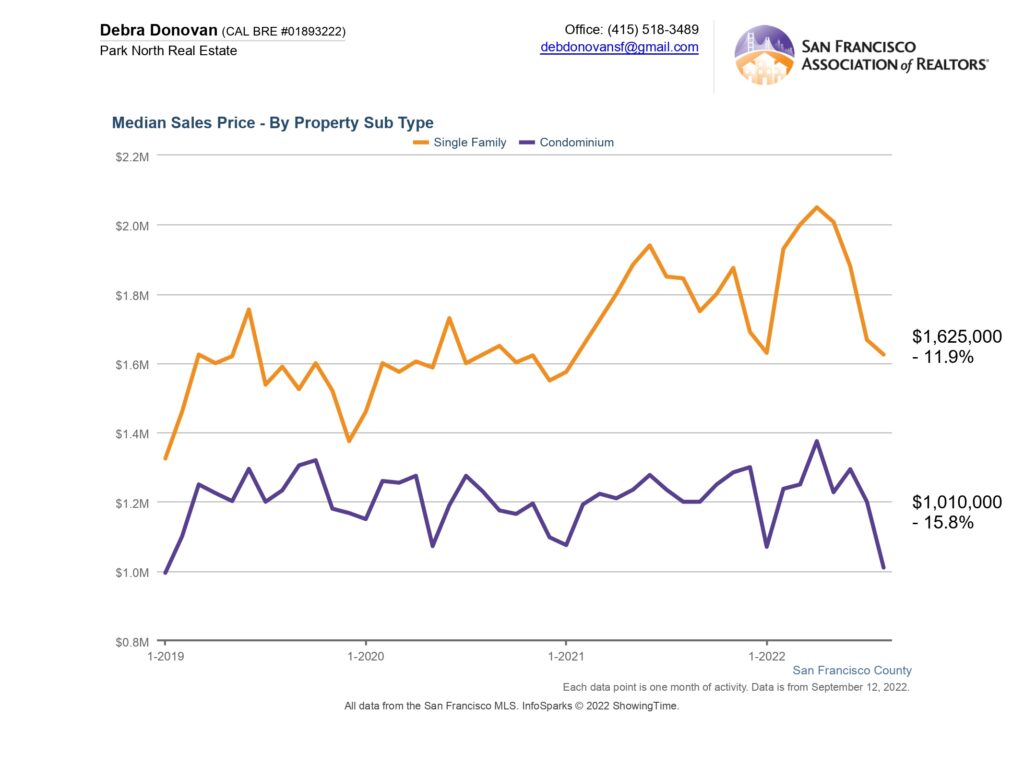
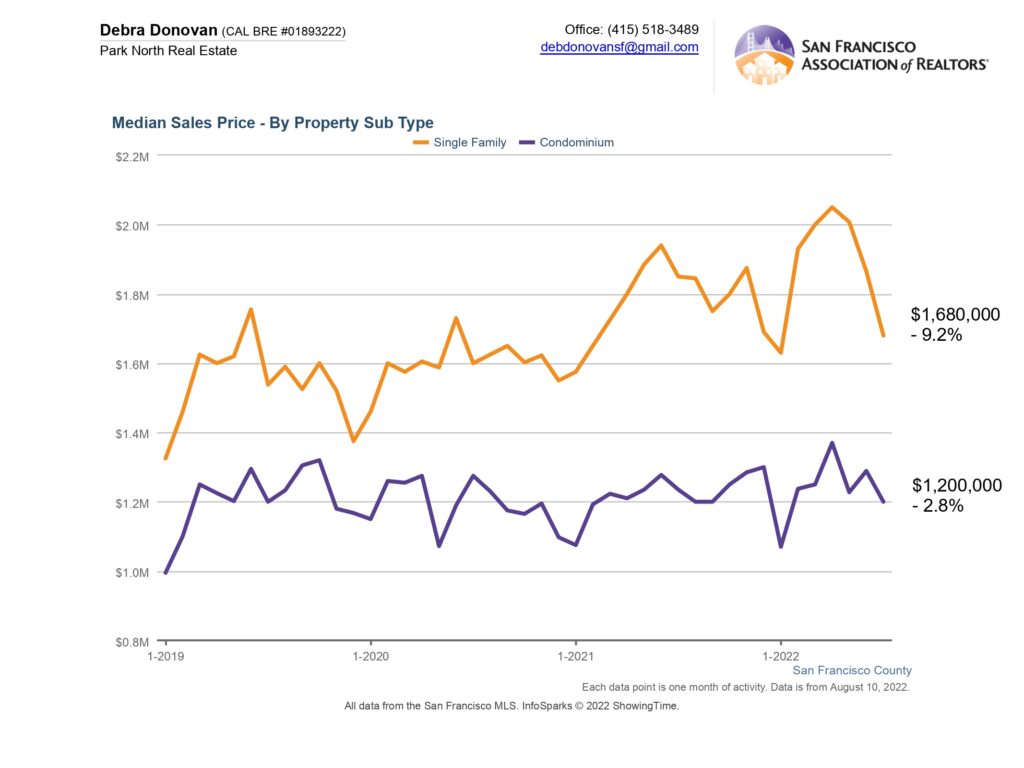
The median price for a single family home slipped almost 12% year over year to $1,625,000. Condo prices slipped almost 16% to $1,010,000.

Sold Listings:

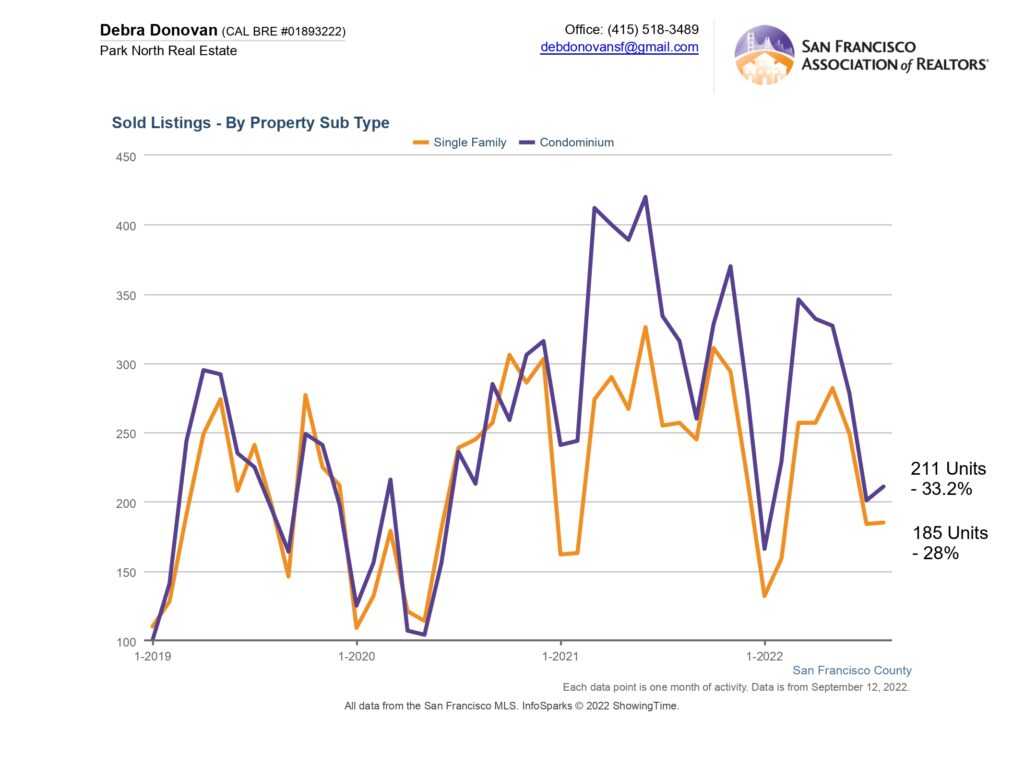
As demand lessens, the number of sales has also dropped. Single family home sales were down 28% year-over-year, while condos were down 33% compared to last August.

Percentage of Properties Sold Over List Price:

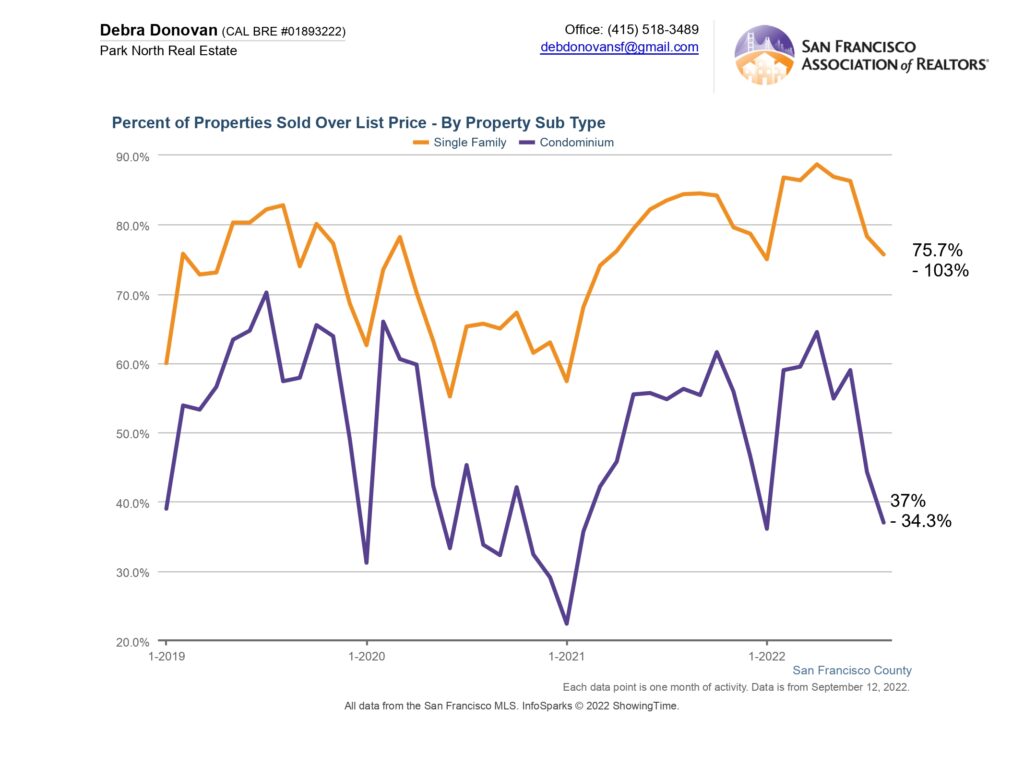
Three-quarters of single family homes sold for over their list price in August, down 10% compared to last year. Thirty seven percent of condos sold for over their list price, down 34% year-over-year. Cooling demand means less competition, though there are still some homes that are selling well over their asking price while others receive just one or two or even no offers.

Average Percentage of List Price Received:

On average, single family homes sold for 108% of their list price, down 6.4% compared to August 2021. Condos sold for an average of 100.8%, down 3.5% year-over-year. For serious buyers who are still in the market, it’s an opportunity to  take advantage of less competition.

Average Days on Market:

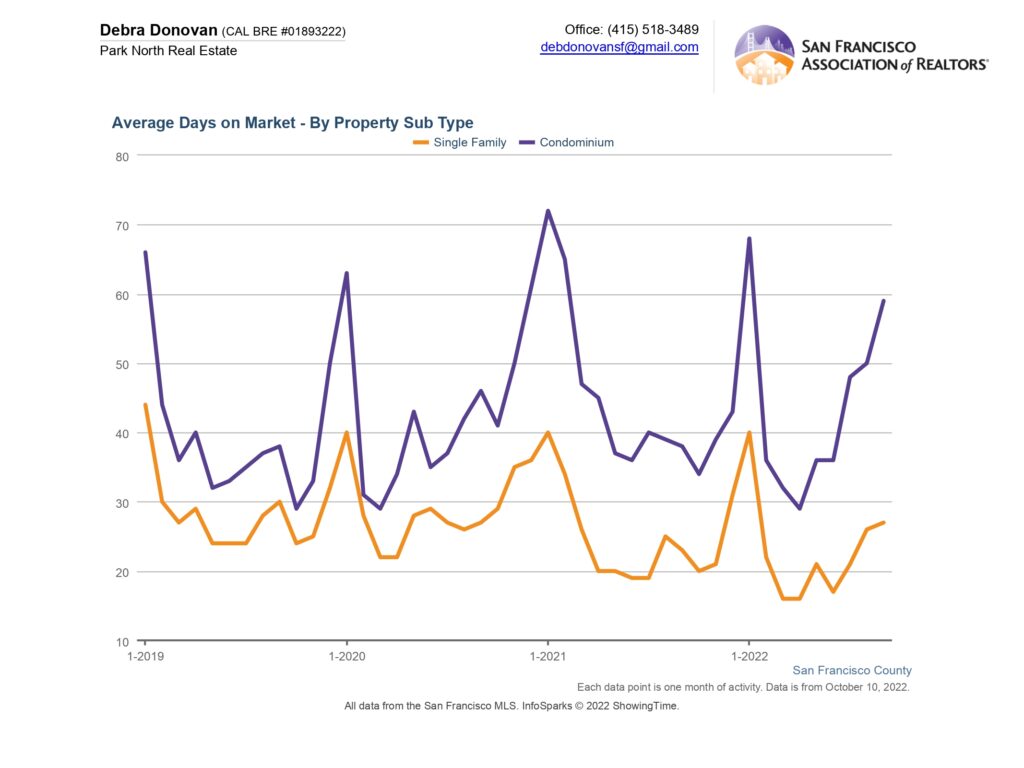
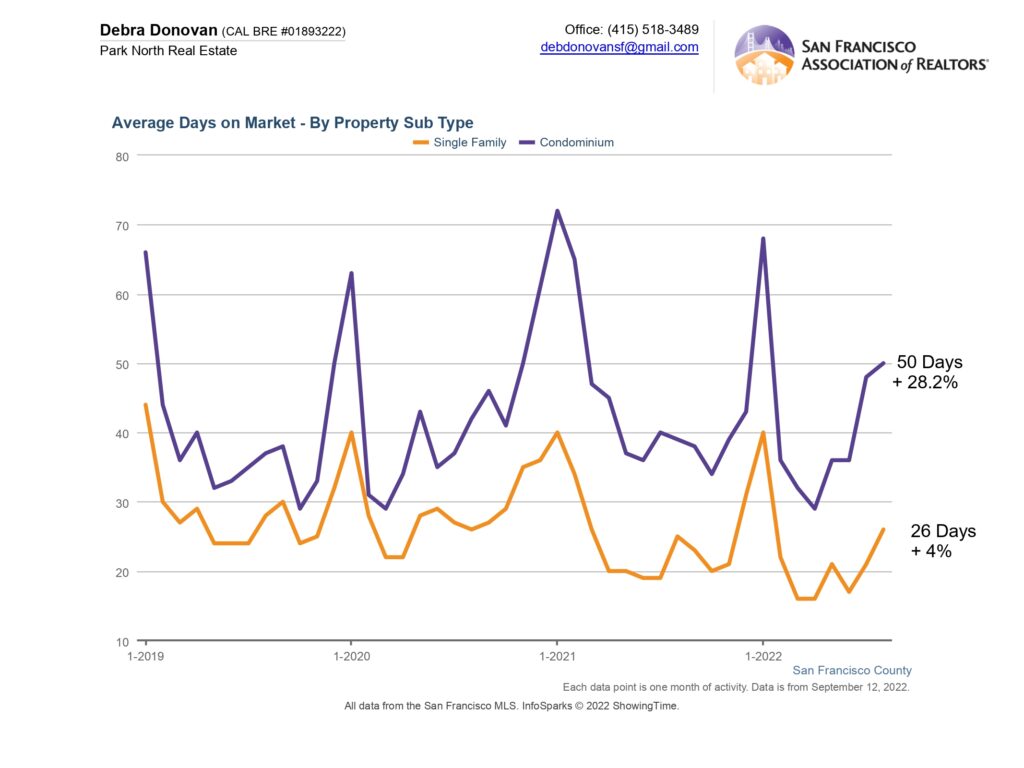
In August, single family  homes spent an average of 26 days on the market before accepting an offer. This is up 4% compared to last year. Condos spent an average of 50 days on the market, up 28% year-over-year.

The fine print: All information deemed reliable but not guaranteed or warranted. Data comes from the MLS so does not include off-market and most new construction condo sales. The Bay Area real estate market is dynamic so statistics can change on a daily basis. These statistics are meant to be a snapshot of the day and time they were pulled.


Real Estate Agent with Park North Real Estate CA DRE# 01893222

August 2022 San Francisco Real Estate Market Update

San Francisco Real Estate

The San Francisco real estate market continued the cooling that began in June. Median sales prices were down year-over-year, as was how much buyers needed to or were willing to overbid to get a home. The average days on market also increased, while the number of sold listings fell..

The cooling, though, is not definitive across the board. While many homes are selling just around, or even below, their asking price others are selling for far above their list price. Some of this is due to shifts in pricing strategy. Changing is  the game plan of under pricing a property by ten to twenty percent to foster more competition and more offers. This is particularly true in the condo and TIC markets, but even single family home sellers have been adopting more transparent pricing. This is good news for buyers who in the past have been frustrated with this practice.

Median Price:

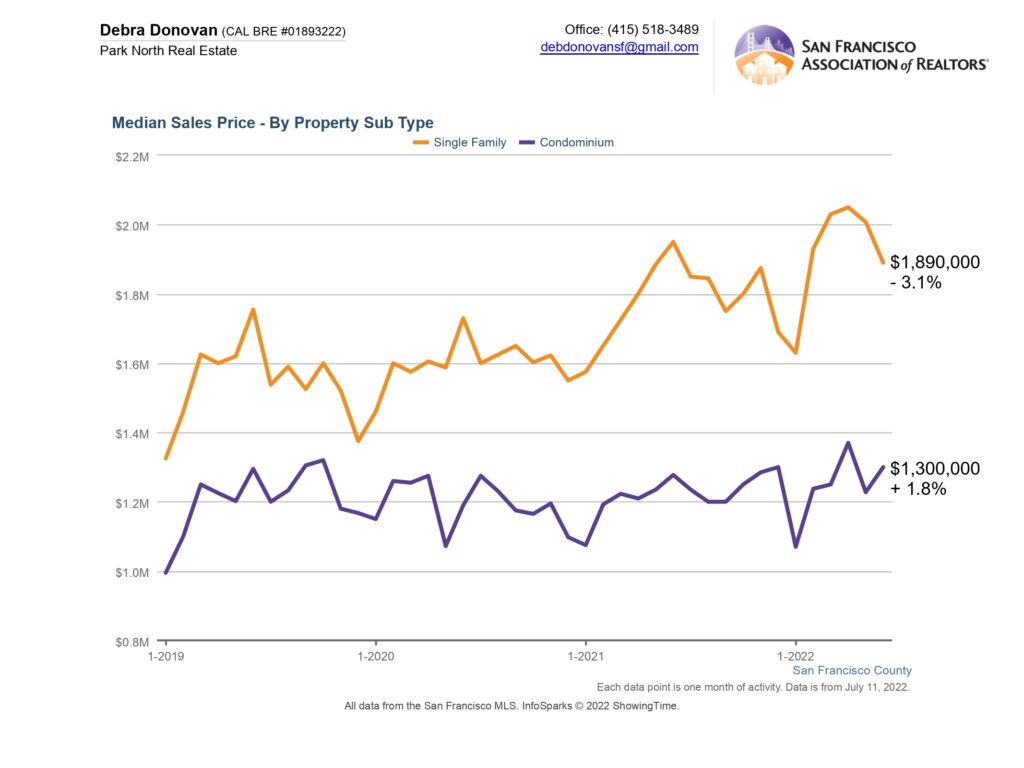
The median sales price for a single family home dropped again in July compared to July 2021, decreasing over 9% year-over-year. Condos also decreased almost 3% compared to last July.

New Listings:

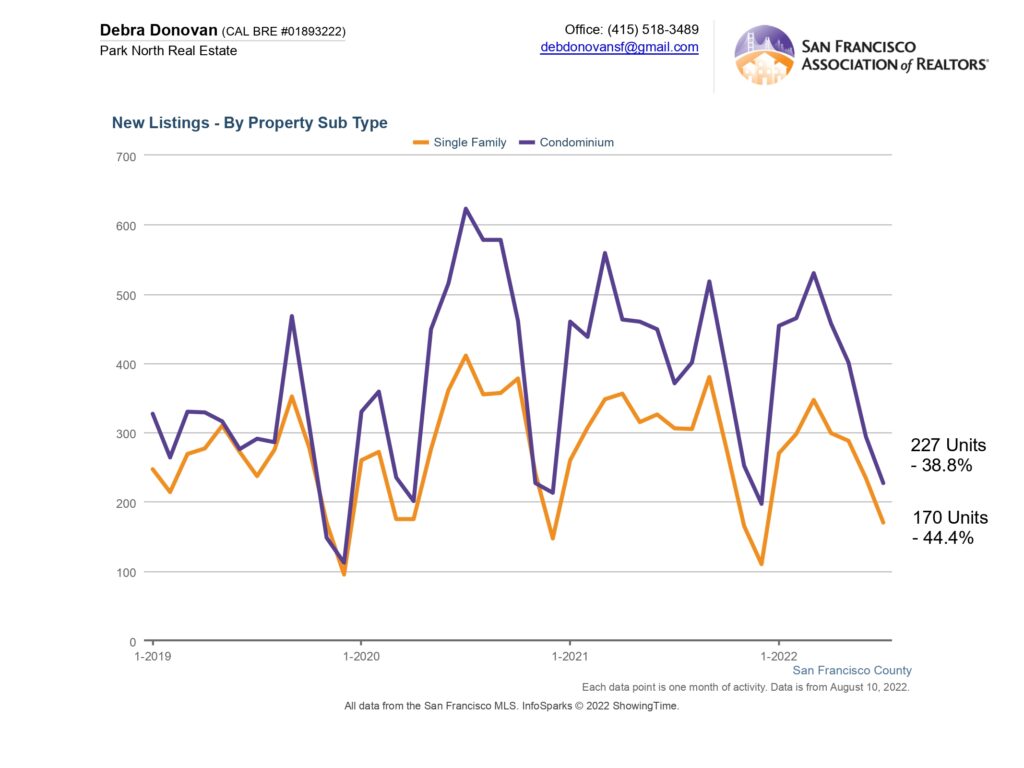
New listings were also down year-over-year in July, a month that is typically among the slowest in San Francisco real estate. This could be just a rightsizing after the past two pandemic years, which saw higher than normal inventory in both July 2020 and July 2021. This July’s new listing numbers are more in line with pre-pandemic July data in San Francisco. New single family homes were down almost 45% and condo listings were down about 27%.


Active Listings:
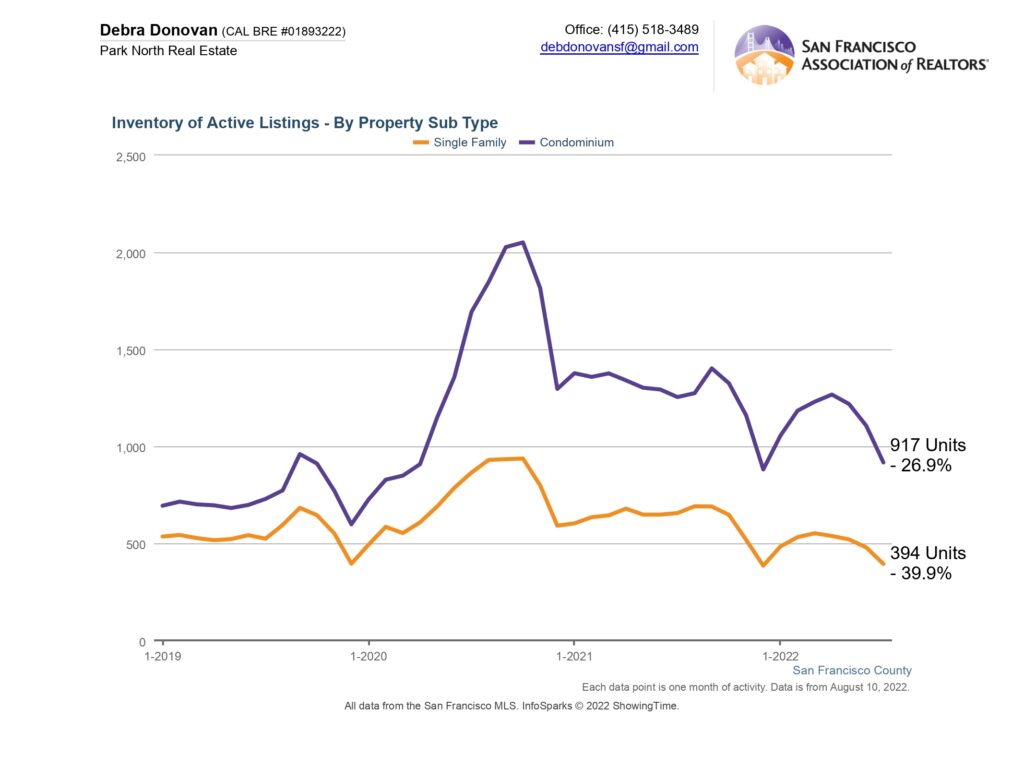
Like new listings, active listings were also down in July. Active single family homes were down 40% while condo listings were down 27%.

Sold Listings:

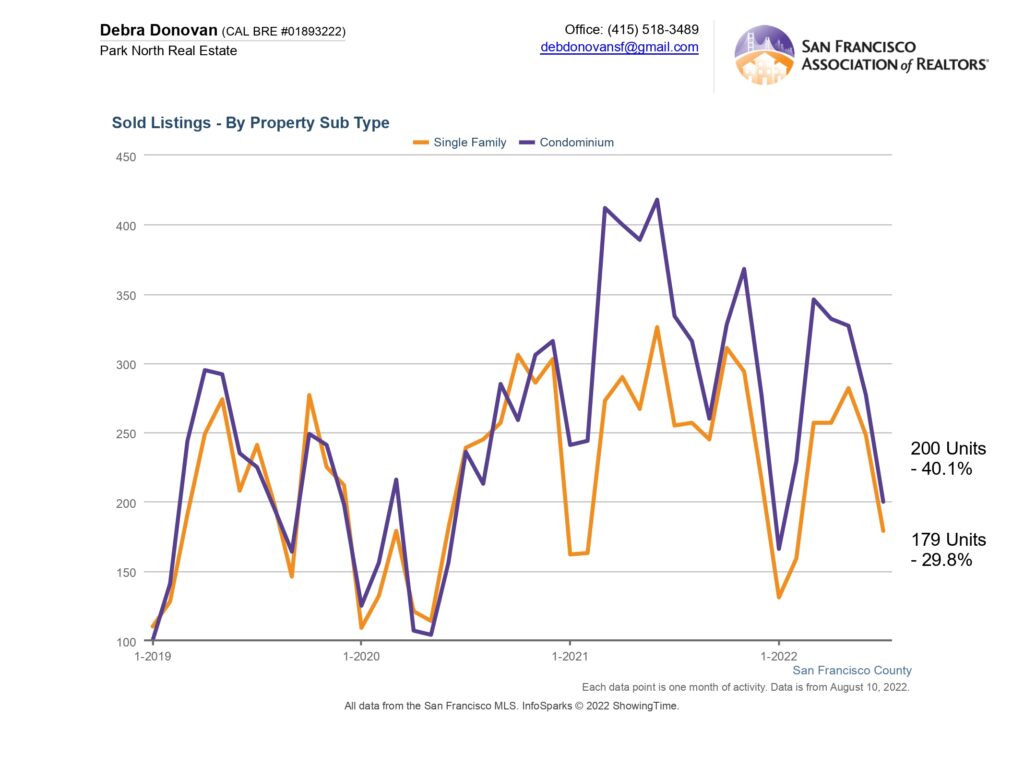
Fewer homes sold in July 2022 than they did in the same month last year. Single family homes sales were down almost 30% while condo sales were down over 40%.

Percentage of Properties Sold Over List Price:

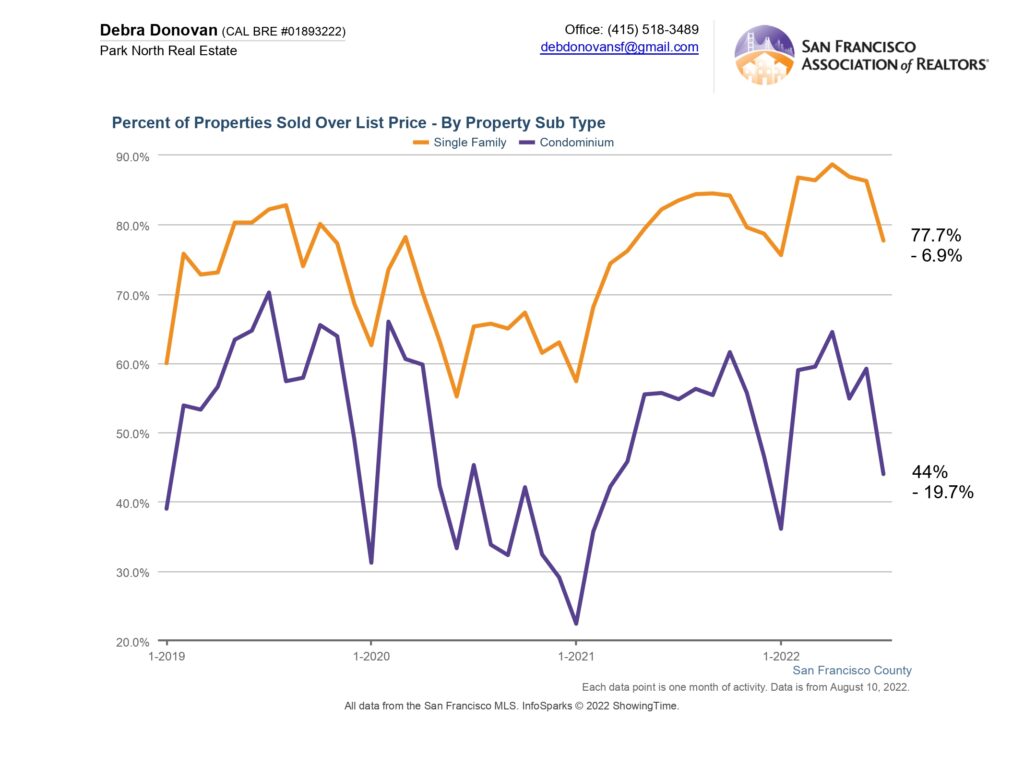
A smaller percentage of homes sold for over their list price in July. Whereas about 85% of single family homes were selling over their list price in 2022, in July only 78% sold over their asking price. That’s also down 7% compared to last July. Condos, of which more than half were selling over their list price this year, had just 40% sell over list price in July. That’s also down almost 20% from the same month last year.

Average Percentage of List Price Received:

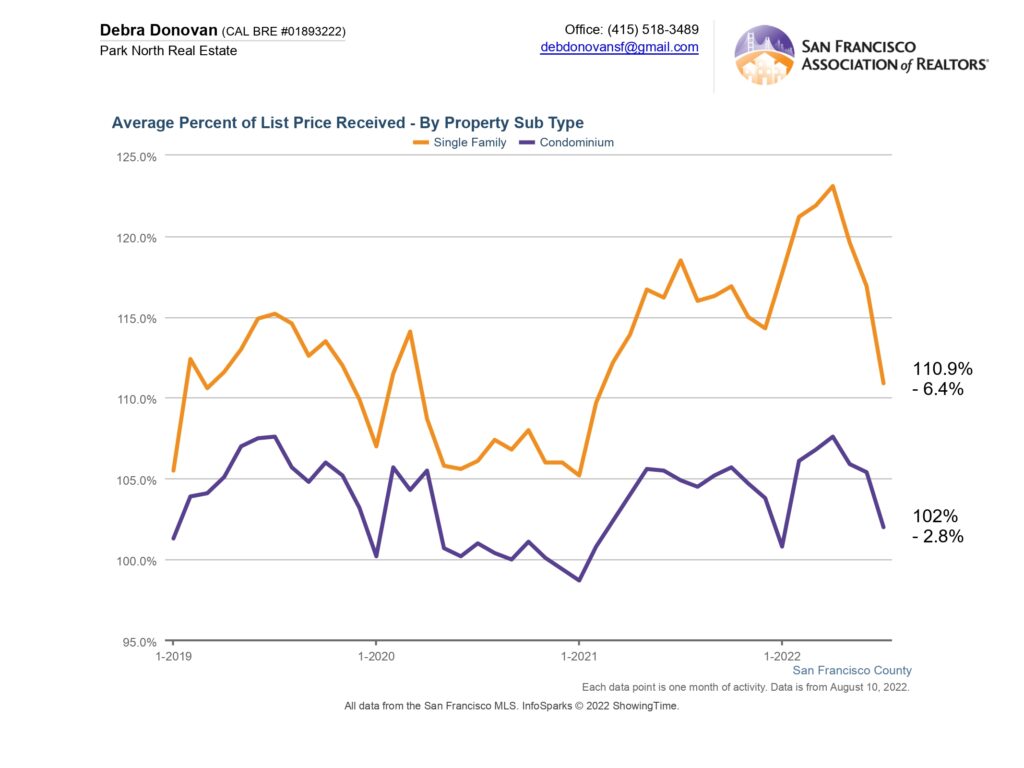
Single family homes sold for an average of 111% of their list price in July, down more than 6% year-over-year. Condos sold for an average of 102% of their list price, down almost 3% compared to July of last year.

Average Days on Market:

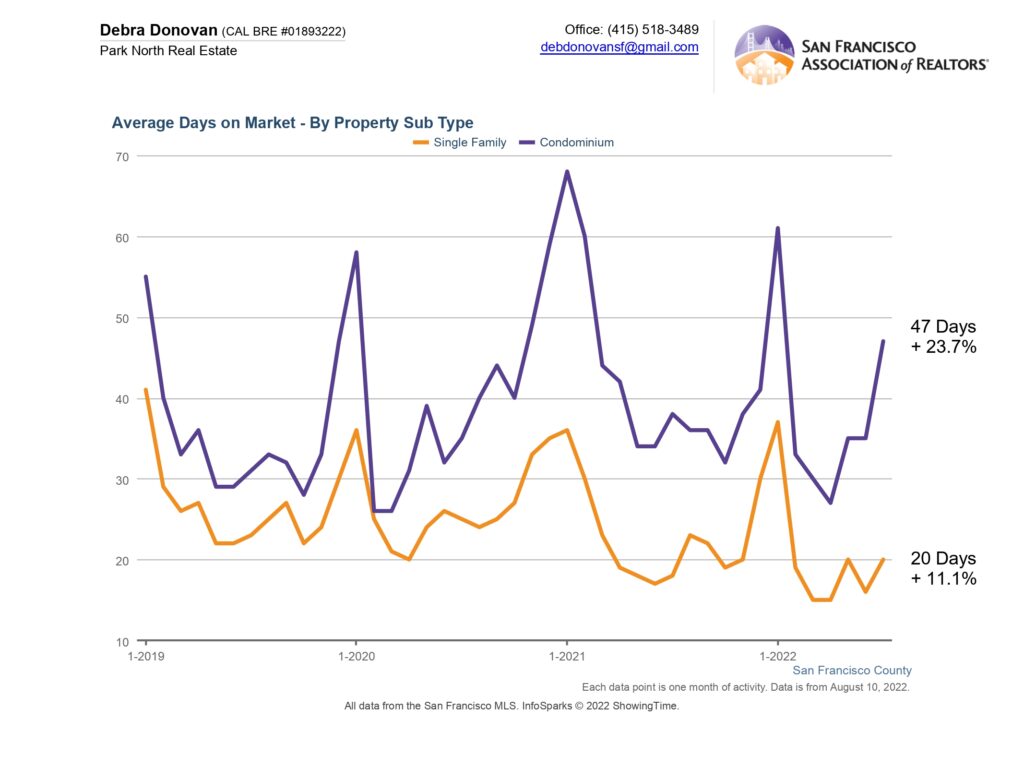
Single family homes spent an average of 20 days on the market in July, up 20% compared to the same month last year. Condos spent an average of 47 days on the market before accepting an offer, up almost 24% year-over-year.

Months Supply of Inventory:

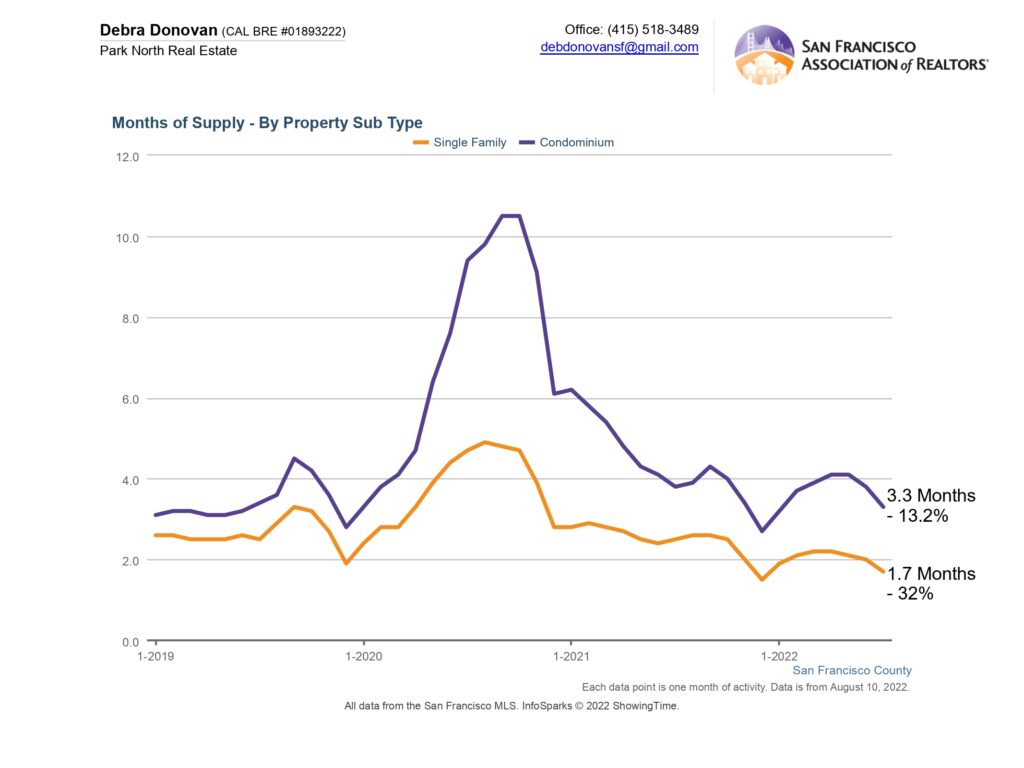
Single family homes had less than 2 months of inventory in July, down 32% compared to last July. Condos had a little over 3 months of inventory, down 13% year-over-year.


The fine print: All information deemed reliable but not guaranteed or warranted. Data comes from the MLS so does not include off-market and most new construction condo sales. The Bay Area real estate market is dynamic so statistics can change on a daily basis. These statistics are meant to be a snapshot of the day and time they were pulled.


Real Estate Agent with Park North Real Estate CA DRE# 01893222

July 2022 San Francisco Real Estate Update

San Francisco Real Estate

June appears to be a turning point in the real estate market. Inflation grew as did increased warnings of a coming recession. The Fed increased interest rates by three quarters of a point, the largest increase in three decades. All of this put a pause on the real estate market as buyers (and sellers) waited to see what would happen and to psychologically at least adjust to the higher rates. Not helping, particularly here in San Francisco and the greater Bay Area, was a significant downturn in tech stocks. Some buyers were knocked out of the market as the higher interest rate thwarted their ability to get a loan. Others were loath to cash out their stocks needed for the down payment.

According to California Association of Realtors, the number of home sales in California dropped 21% in June, and median prices dropped 4% compared to May. San Francisco also saw a slight decline in median prices for single family homes.

It’s important to note that one month of data does not a trend make. While it’s pretty clear that the Fed will increase rates again this month to combat inflation, it’s still unclear as to whether we are in a recession or if a recession is inevitable later this year.

Read on to see the latest stats in the San Francisco real estate market.

Median Price:

For the first time in perhaps a decade, the median price for a single family home in San Francisco slipped year-over-year in June 2022. The median price was also down compared to last month. Amid the highest inflation rate (at that time), a 3/4 point interest rate increase from the Fed, and tech stocks declining, it’s not really surprising that the market hiccuped in June. There was more positive news from the condo segment of the market, where median prices grew almost 2% year-over-year, and were also up slightly compared to May.


New Listings:

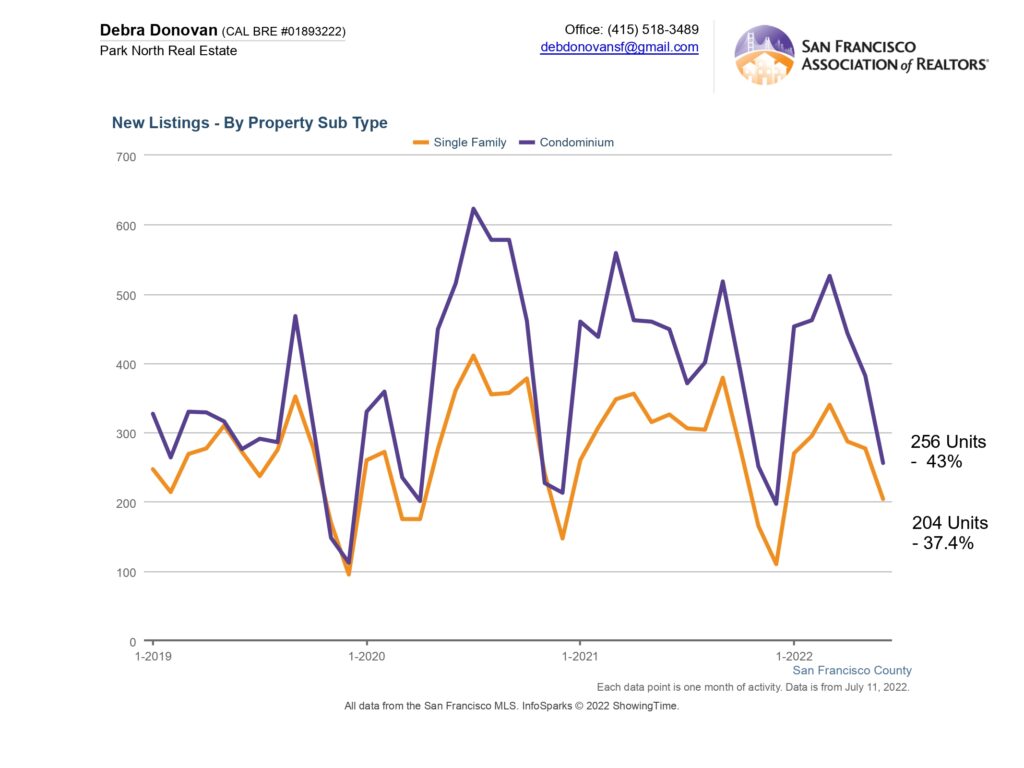
While prices may have wavered, our continuing dearth of inventory continued in June and perhaps held the market up in spite of less demand. New single family home listings were down 37% compared to June 2021. New condo listings were down over 40%.


Active Listings:

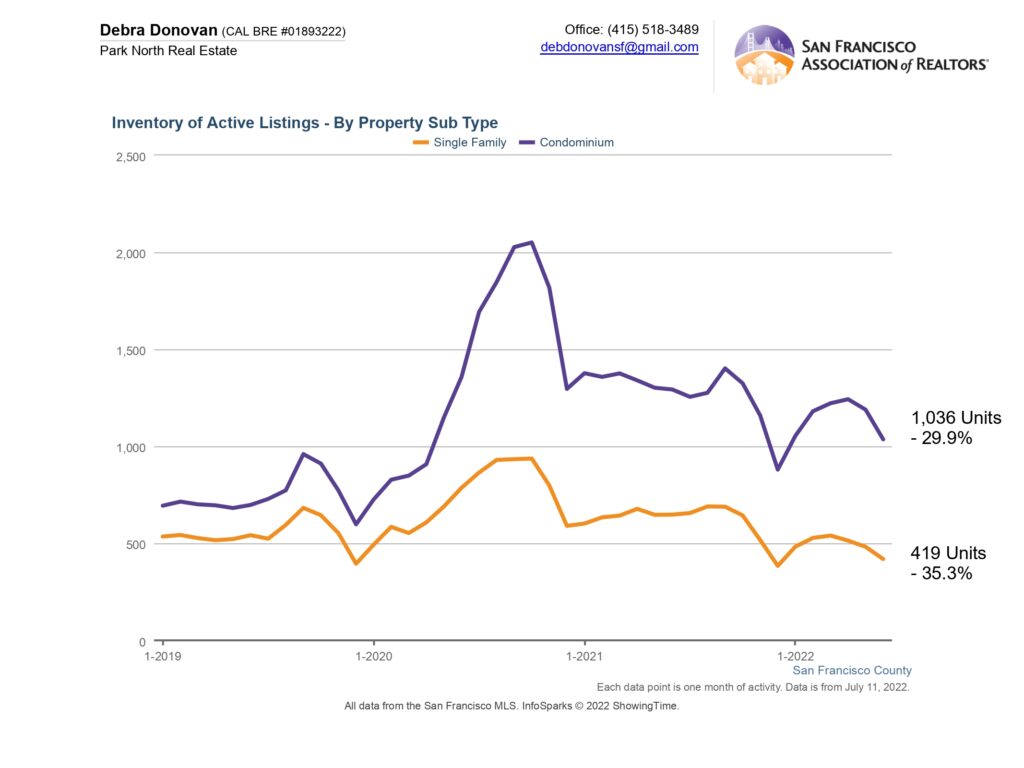
Like new listings, active listings were down compared to June of last year for both single family homes and condos in San Francisco. Active listings are the number of listings still on the market for sale at the end of the month. Active single family homes were down over 35% while condos were down almost 20% year-over-year.


Sold Listings:

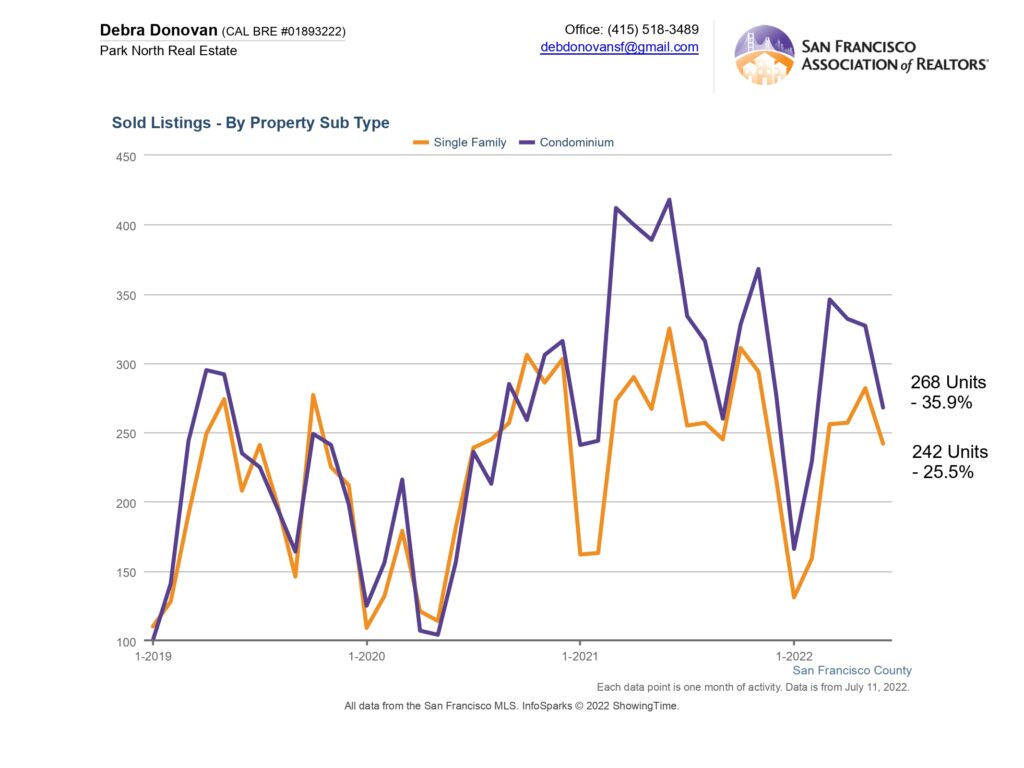
Overall sold listings were down for both single family homes and condos. The number of single family homes sold in June was down over 25% compared to June last year. The number of condos sold were down 36% year-over-year.


Percentage of Properties Sold Over List Price:

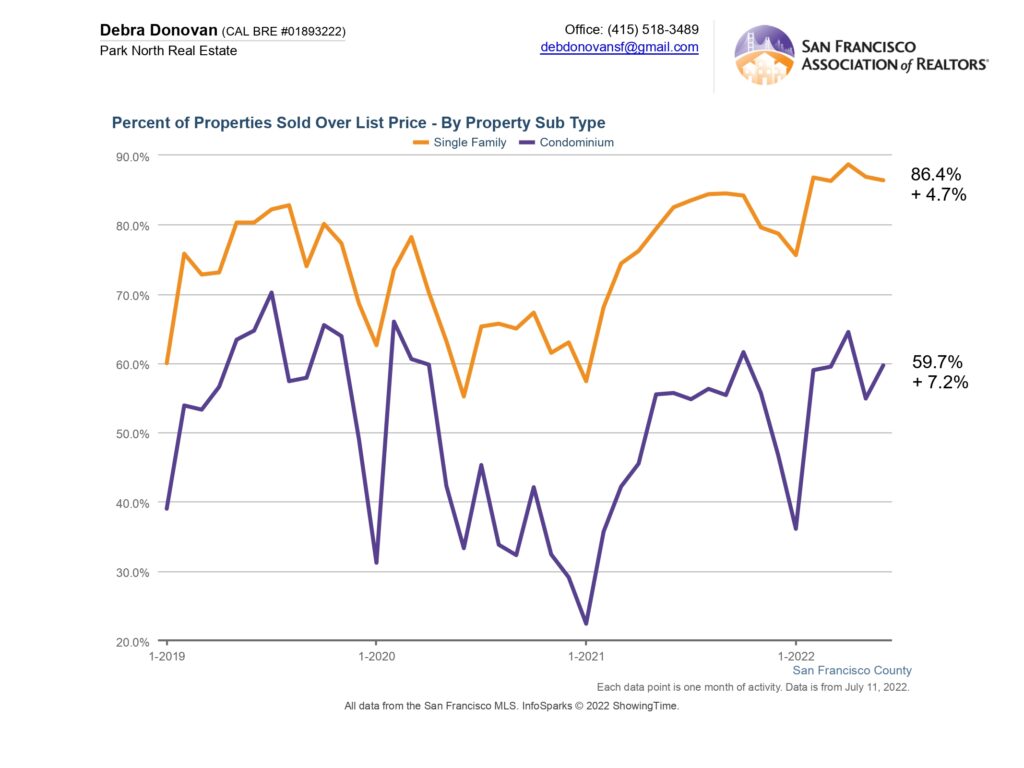
More than 87% of single family homes sold for over their list price in June, up almost 5% from last June. Almost 60% of condos sold over their list price, up over 7%.


Average Percentage of List Price Received:

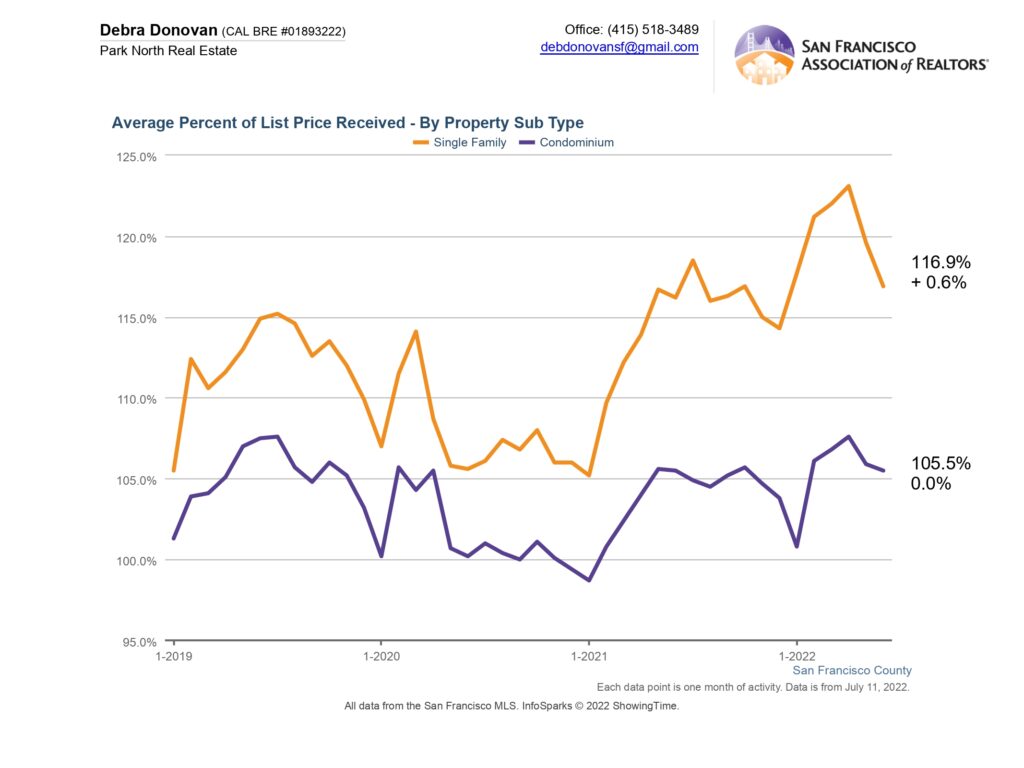
The average percentage of list price single family homes received was almost 117%. But that’s up less than 1% year-over-year. Condos sold on average for 105.5% of list price, with no change when compared to last June.


Average Days on Market:

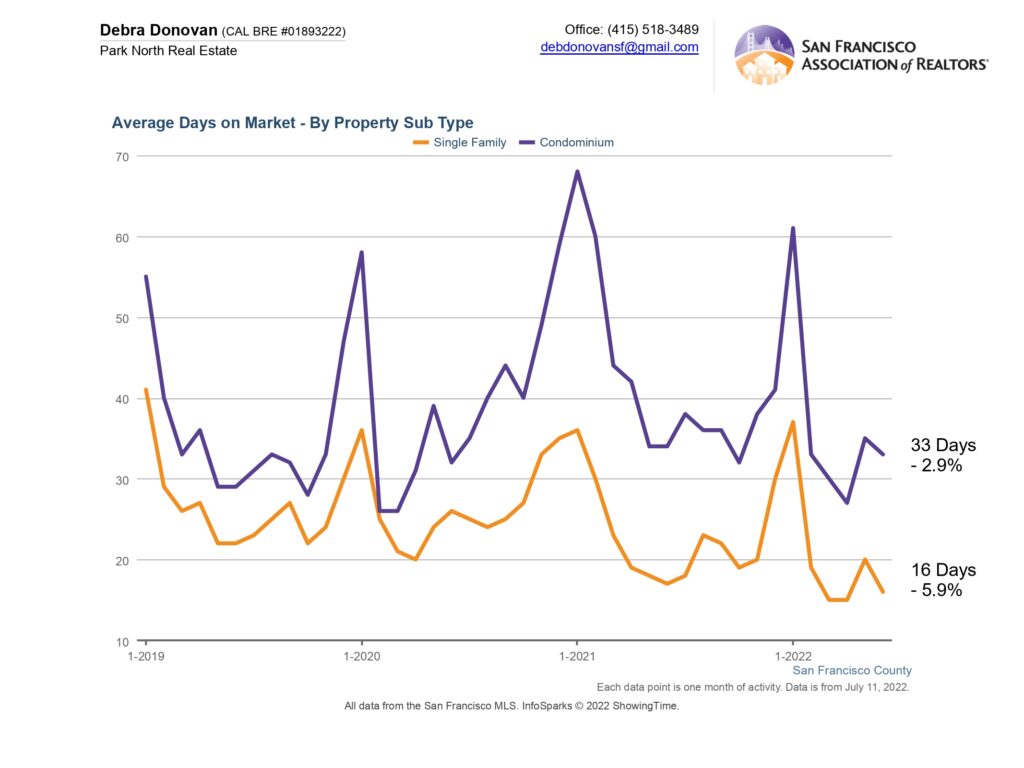
Single family homes spent an average of just 16 days on the market in June, down almost 6% compared to last June. Condos spent 33 days on average on the market before accepting an offer, down about 3% year-over-year.


Months Supply of Inventory:

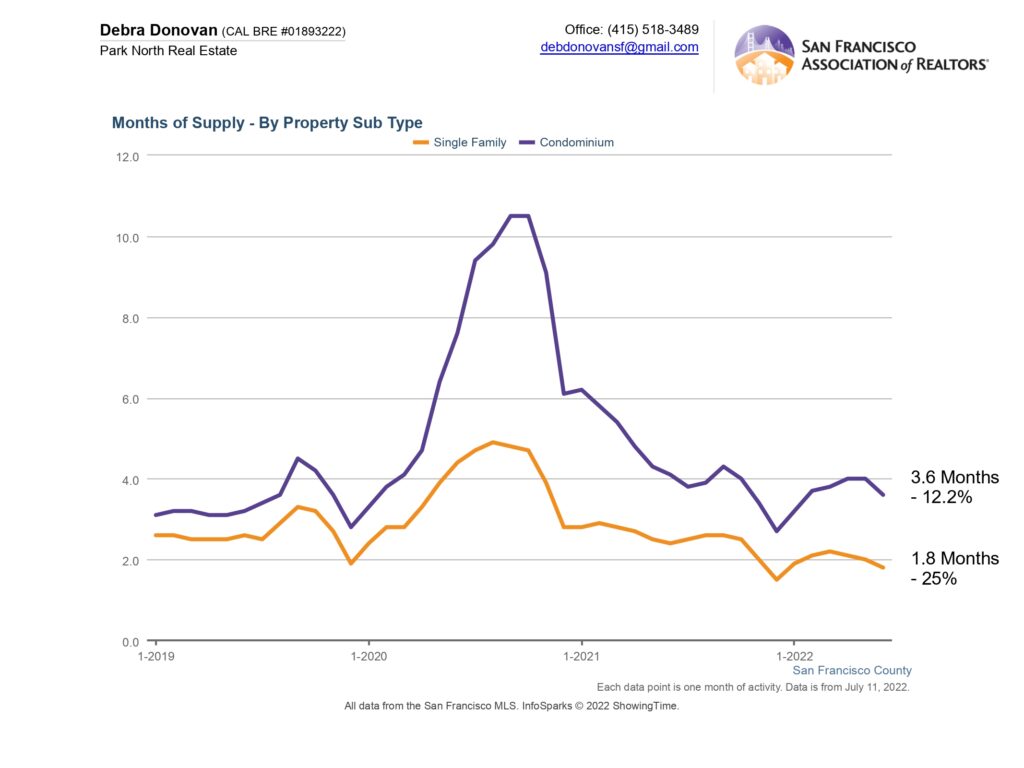
In June, single family homes had just 1.8 months of inventory, down 25% compared to last June. Condos had just 3.6 months of inventory, down more than 12%. MSI refers to the number of months it would take for the current inventory of homes on the market to sell given the current sales pace. For a balanced market, MSI would be about 6 months.

The fine print: All information deemed reliable but not guaranteed or warranted. Data comes from the MLS so does not include off-market and most new construction condo sales. The Bay Area real estate market is dynamic so statistics can change on a daily basis. These statistics are meant to be a snapshot of the day and time they were pulled.


Real Estate Agent with Park North Real Estate CA DRE# 01893222

2021 San Francisco Real Estate Market Wrap-up

San Francisco Real Estate

For so many reasons, we could sum up 2021 as another year-long dumpster fire. But that’s not so for the San Francisco real estate market, which continued to be red hot. Single family homes were the hottest ticket in town, with buyers clamoring to overbid to get in the door. The condo market, which has struggled since the onset of the pandemic, continued to recover in 2021 and is back on the rise, particularly in the $2M+ range which saw the biggest price gains. Lower priced units, under $1.M actually decreased, which could be a combination of buyers requiring more space now that Covid has changed how many of us work and also that there are fewer properties still selling for under $1M in San Francisco. Here are a few stats from 2021.

Median Sales Price:

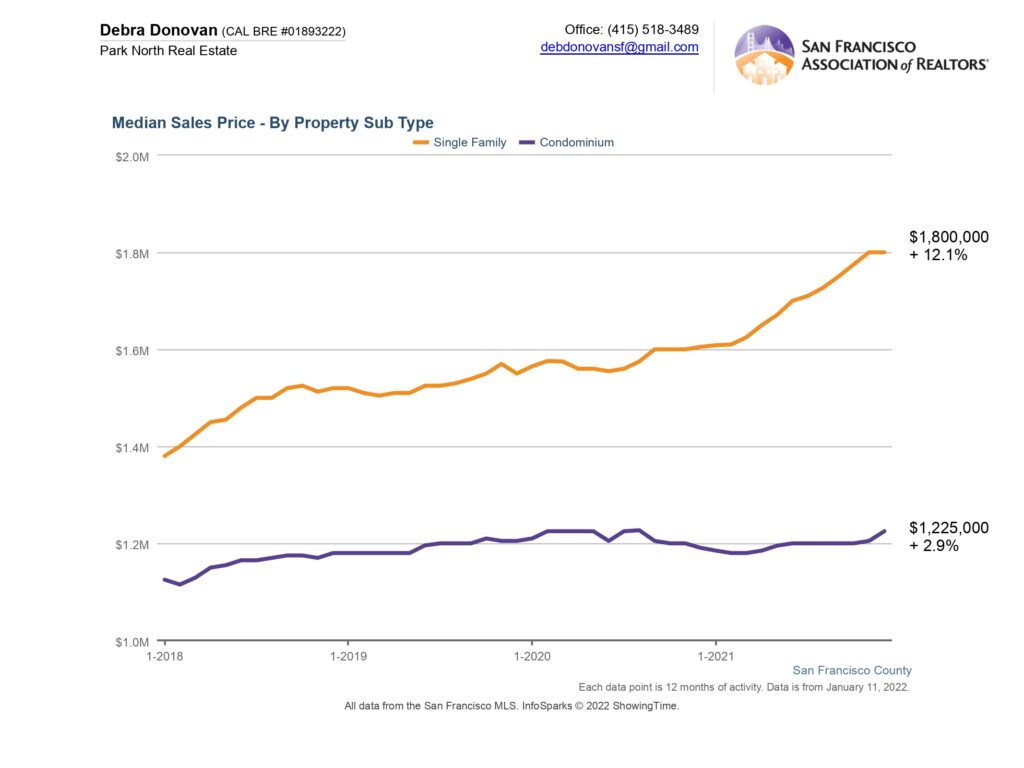
The median price for a single family home in San Francisco grew 12% compared to 2020, reaching another new high of $1,800,000. Condos saw an almost 3% increase compared to the previous year, rebounding to $1,225,000.


New Listings:

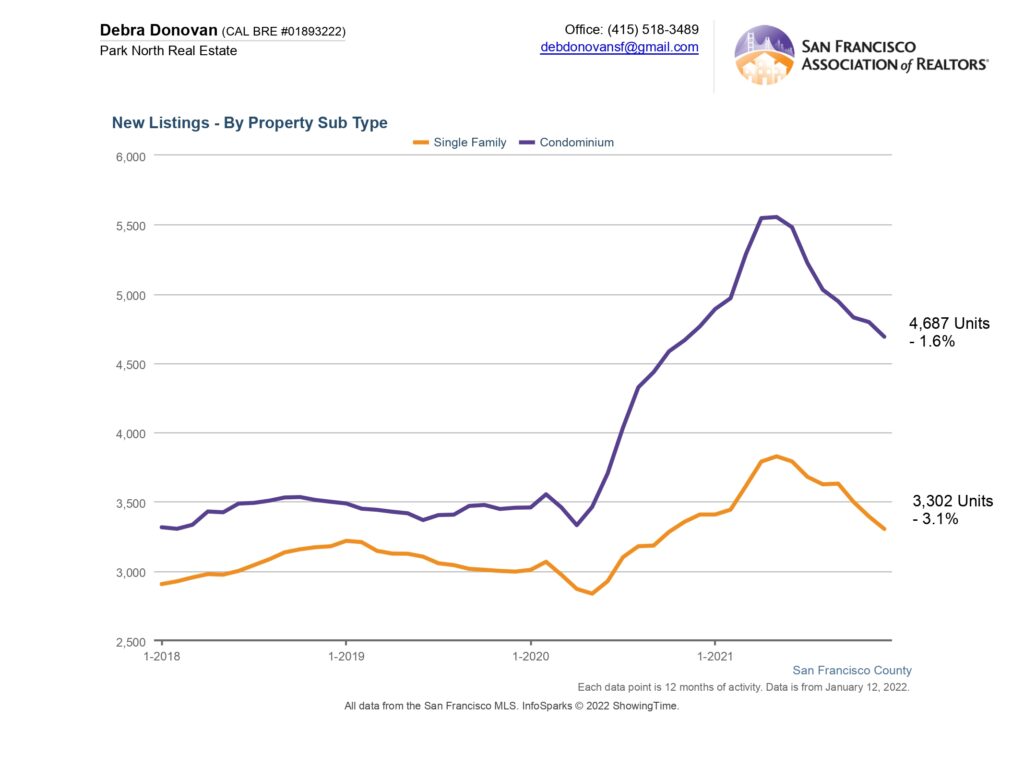
New listings were down across the board in 2021. New single family homes were down 3% year-over-year, new condo listings were down almost 2%. This led to increasing prices due to the imbalance of supply and demand.

Active Listings:

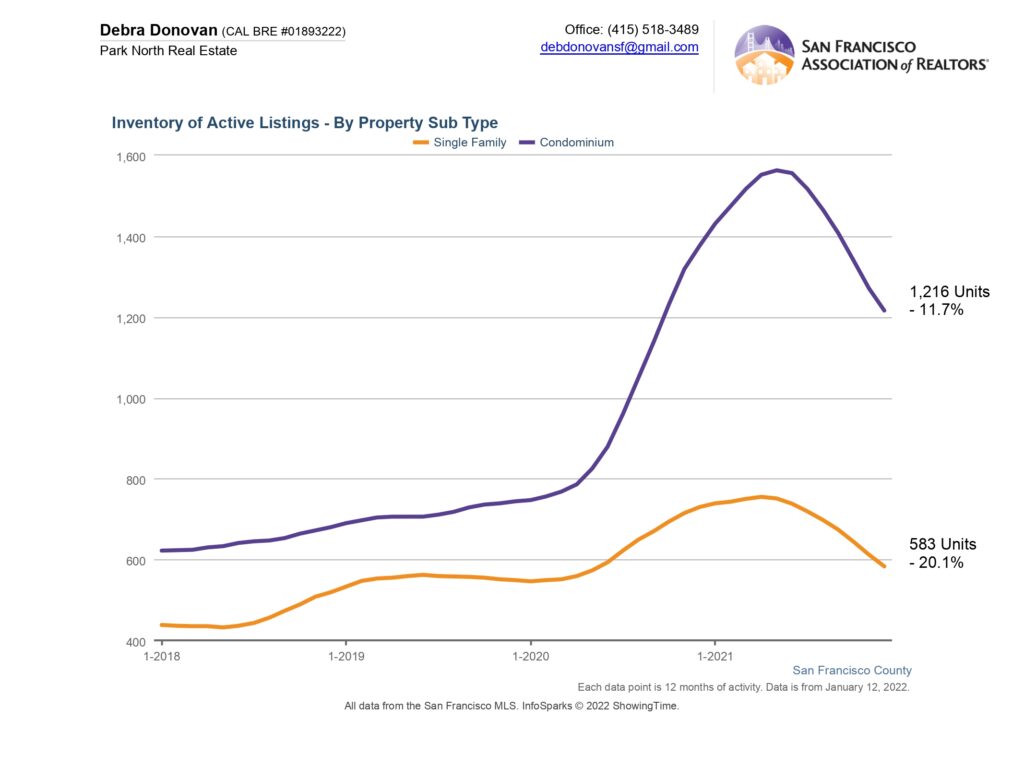
It’s no surprise that active listings, those homes available for sale at the end of a month, were also down. With fewer new listings coming on the market but equal or greater demand, competition in some cases was fierce and did not leave much on the market by month’s end. Active listings for single family homes was down 20%, while condos were down almost 12%.

Sold Listings:

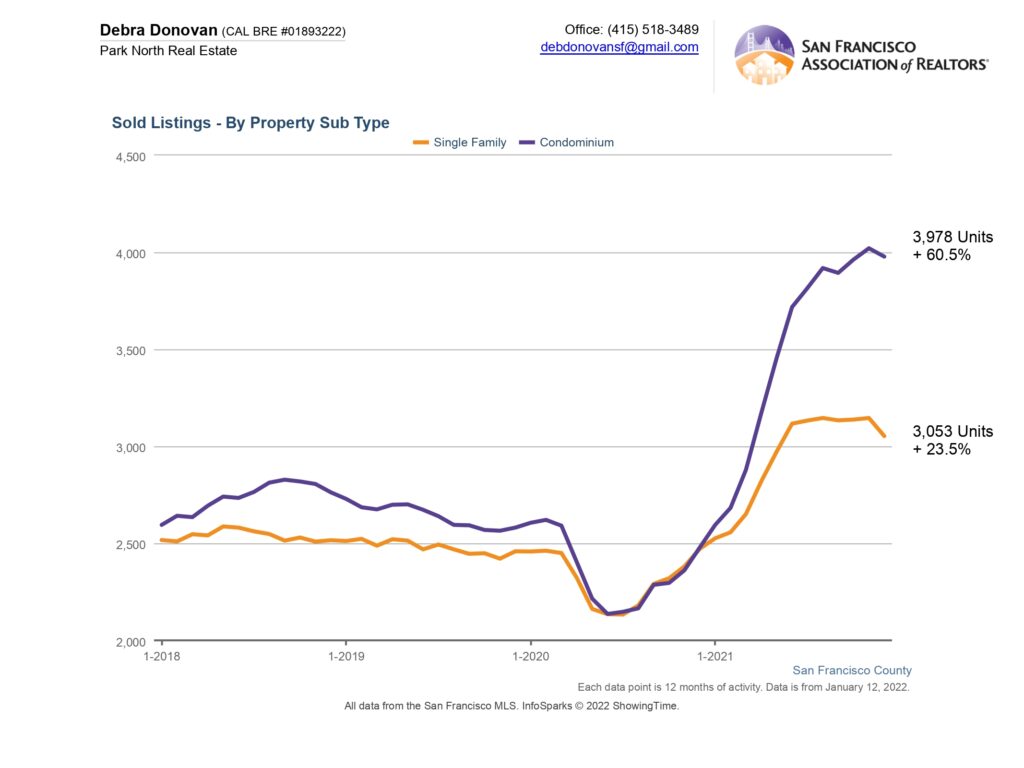
Another yard stick showing how much more quickly properties were selling in 2021 vs the previous year, over 3,000 single family homes sold, up almost 24%. There were almost 4,000 condos that sold in 2021, up over 60% year-over-year.

Percentage of Properties Sold Over List Price:

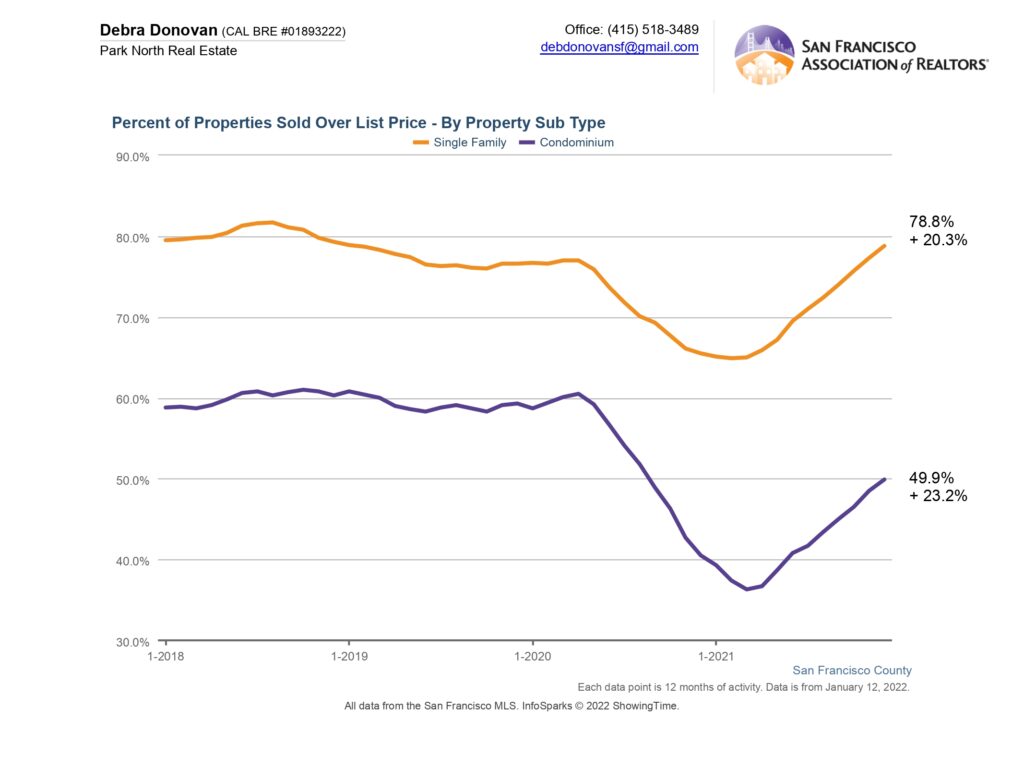
Almost 79% of single family homes sold for over their list price in 2021, up over 20% compared to the previous year. Single family homes have been the hottest ticket in town, so that’s no surprise. About half of condos sold for more than list price, up 23% year-over-year. While the condo market took a hit in 2020, it has been creeping back up to a seller’s market.

Average Percentage of List Price Received:

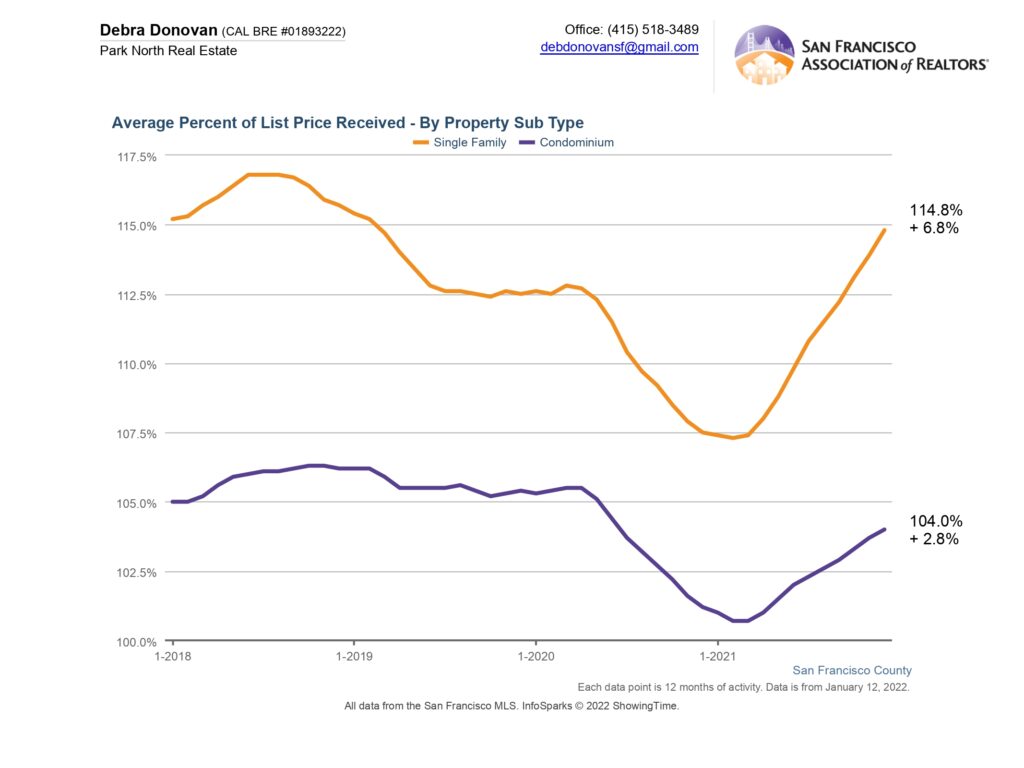
On average, single family homes received about 115% of their list price in 2021, up almost 7% year-over-year. Condos averaged 104% of their list price, also up almost 3% compared to 2020.

Average Days on Market:

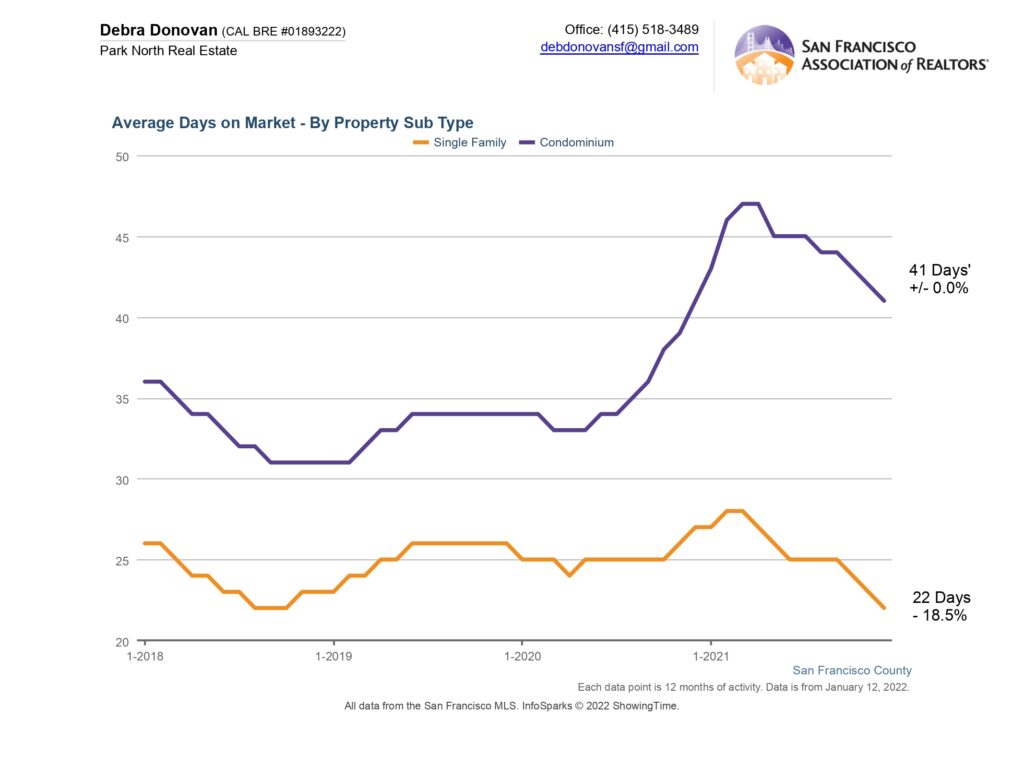
Single family homes spent an average of 22 days on the market before accepting an offer in 2021, down 8.5% compared to 2020. Condos again spent an average of 41 days on the market last year, the same as in 2020.

Months Supply of Inventory:

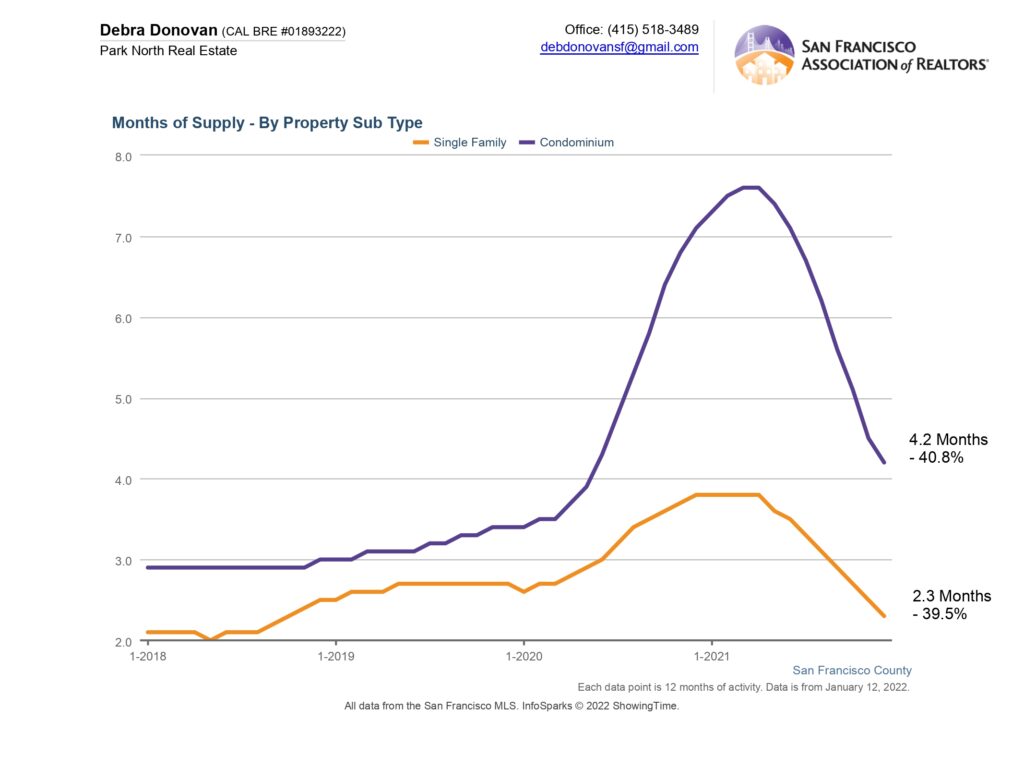
As we’ve seen for most of the past several years, inventory remains low particularly in the single family home market where demand has ramped up even more over the past couple of years. MSI for 2021 was 2.3 months, down 40% compared to 2020. The condo market experienced a steep rise in available inventory in 2020 but in 2021 that was reduced 40% to 4.2 months.

The fine print: All information deemed reliable but not guaranteed or warranted. Data comes from the MLS so does not include off-market and most new construction condo sales. The Bay Area real estate market is dynamic so statistics can change on a daily basis. These statistics are meant to be a snapshot of the day and time they were pulled.