

Tag: san francisco home selling

Home / Tag: san francisco home selling

Real Estate Agent with Park North Real Estate CA DRE# 01893222

Q1 2023 San Francisco Real Estate Market

San Francisco Real Estate

The first quarter of the year was a rocky one for the San Francisco real estate market. The confluence of rising interest rates, inflation, tech layoffs, and a deluge of rain all contributed to a slower than normal January and February, with buyers waiting to see what would happen and sellers postponing their home sales due to weather. Although the weather dried and buyers were back out in force in March, overall it was a lackluster quarter.

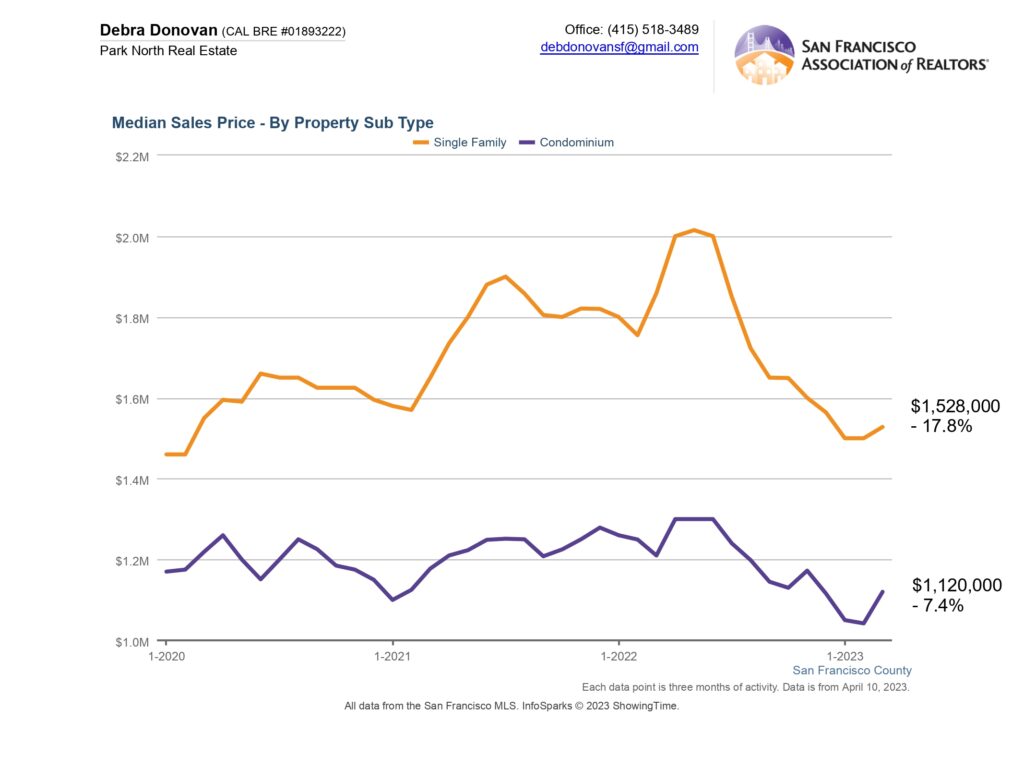
Median Sales Price:
The median price for single family homes dropped almost 18% in Q1 2023 when compared to the same quarter 2022. Condo prices were off over 7% compared to last year.
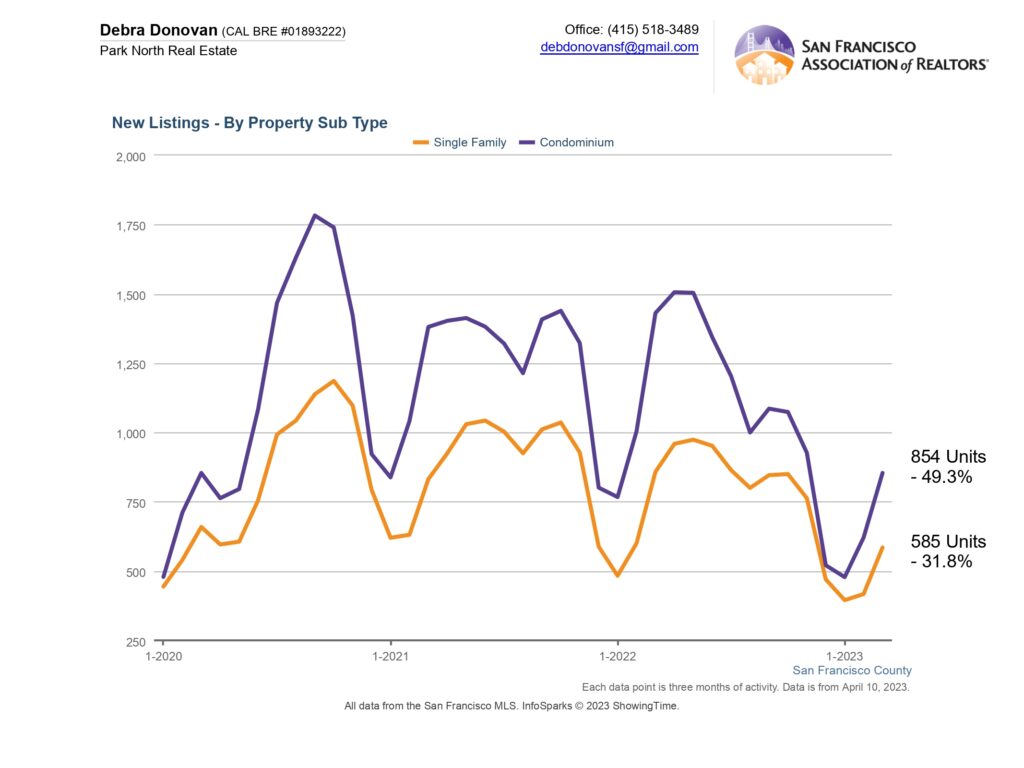
New Listings:

New listings were down significantly for both single family homes and condos. Single family home listings were down almost 32% while new condo listings were down almost 50%. Many who have bought or refinanced for incredibly low interest rates are not as motivated to sell if they don’t have to, leaving a dearth of new properties.
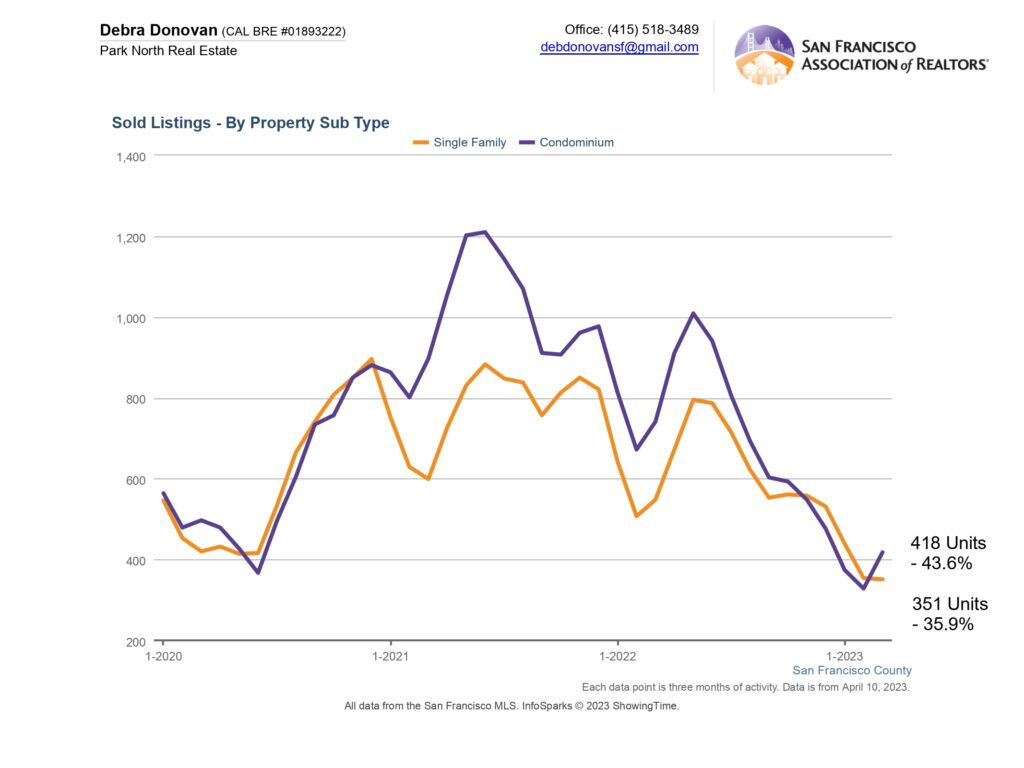
Sold Listings:

The number of listings that sold also decreased in Q1 2023 vs. Q1 2022. Partly this is due to fewer homes on the market, but it’s also because January and February were rainy and slow so homes stayed on the market longer.
Percentage of Properties Sold Over List Price:

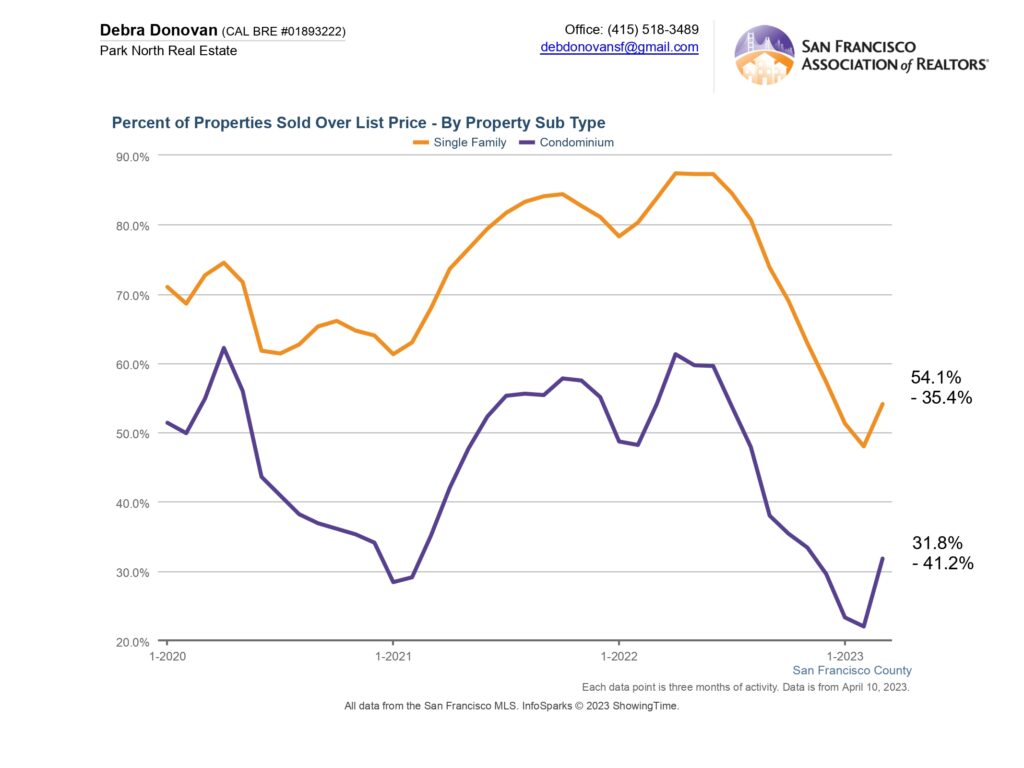
During slow Q1 fewer buyers meant fewer competitive offers and thus, fewer properties selling over their list price. Almost 55% of single family homes sold for over their asking price,  down over 35% compared to the same quarter last year. About 32% of condos sold for more than their list price, down 41% compared to Q1 2022.
Average Percentage of List Price Received:

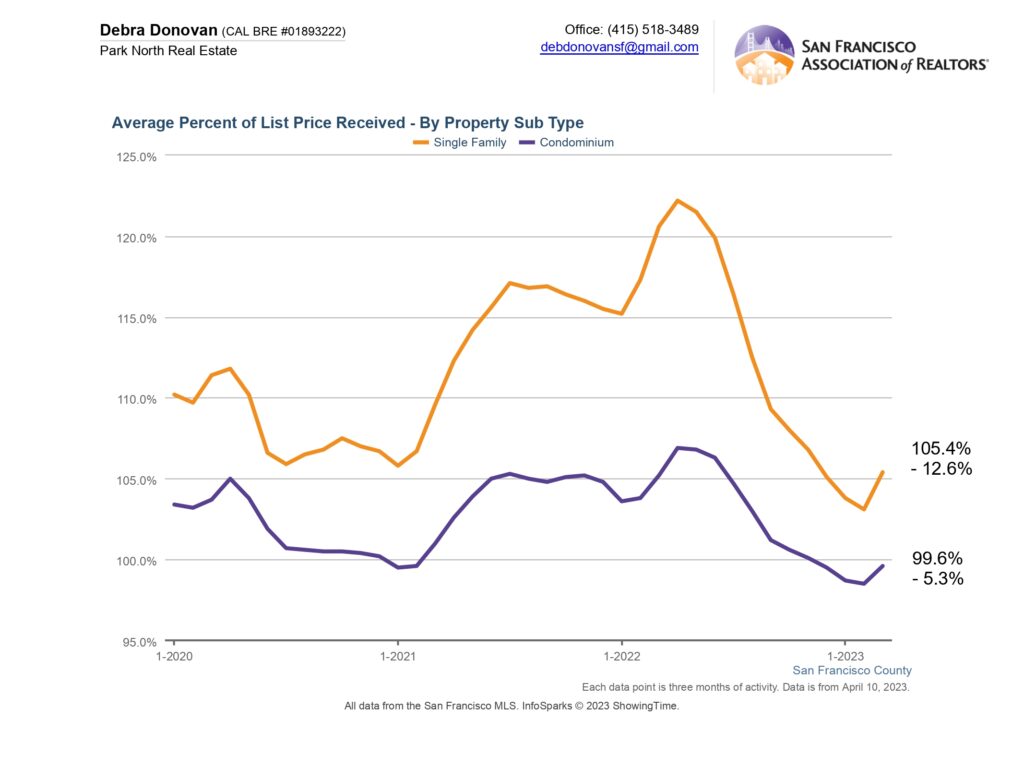
Single family homes sold for an average of 105.4% of list price, down 12.6% compared to over 120% in Q1 2022. Condos sold for an average of 99.6%, or just under list price, in the first quarter. This was down over 5% compared to the same quarter last year.
Months Supply of Inventory:

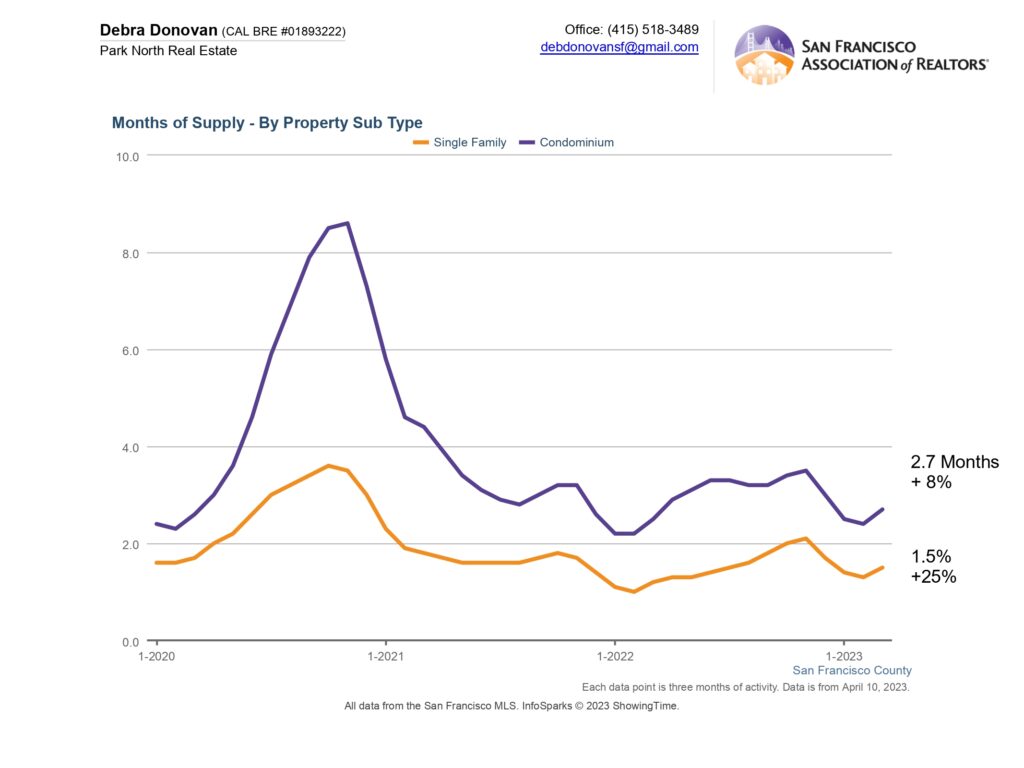
Month’s supply of inventory, or MSI, measures how quickly homes are selling through in the current market. An MSI of 5 months or less is usually considered a seller’s market, and 6+ months  of inventory indicates a buyer’s market. In Q1 2023 single family homes had an MSI or about 1.5 months, still a seller’s market and yet up 25% compared to the same quarter last year. Condos had 2.7 months of inventory, up 8% compared to last year but still in seller’s market territory.
Average Days on Market:

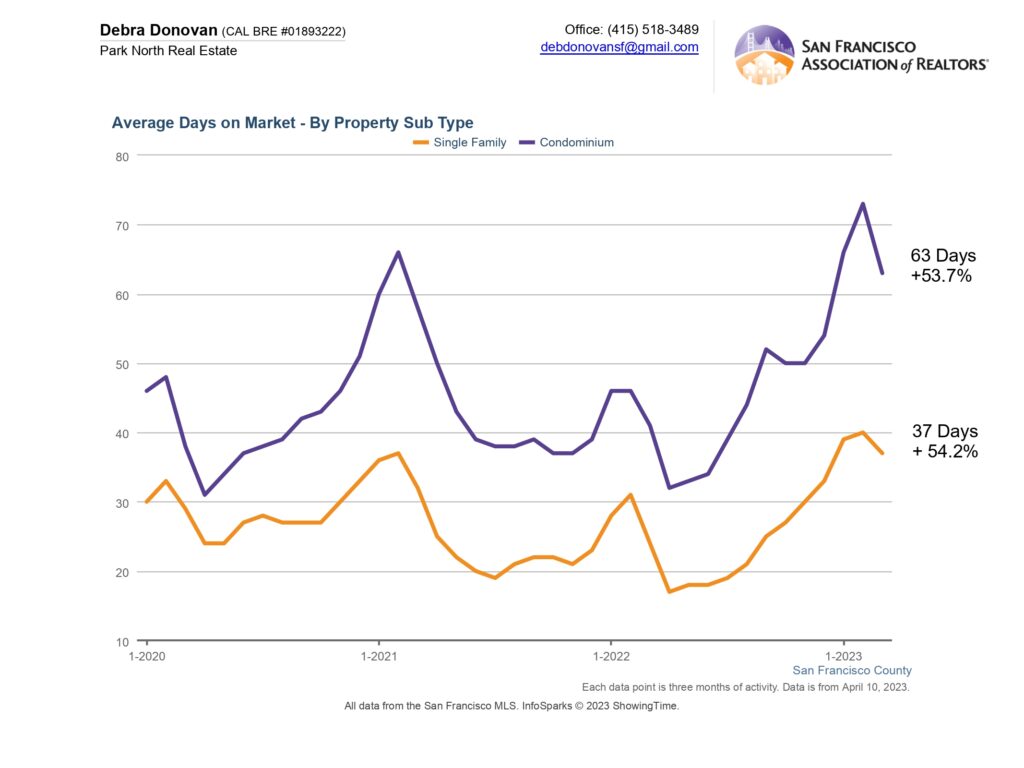
Single family homes spent an average of 37 days on the market before accepting an offer last quarter, up over 54% compared to the same quarter last year. Condos spent an average of 63 days on the market, also up about 54% compared to Q1 2022.
The fine print: All information deemed reliable but not guaranteed or warranted. Data comes from the MLS so does not include off-market and most new construction condo sales. The Bay Area real estate market is dynamic so statistics can change on a daily basis. These statistics are meant to be a snapshot of the day and time they were pulled.
Real Estate Agent with Park North Real Estate CA DRE# 01893222

Selling Your Home in Today’s Market

San Francisco Real Estate

After more than a decade of a strong seller’s market, the San Francisco Bay area real estate market has shifted. Inflation and the rising interest rates meant to combat it has taken a toll with some buyers, and as a result sellers.

One might think it’s all doom and gloom, but one would be wrong. In spite of all of the bad press, buyers are still buying and homes are still closing. But now more than ever sellers need the steady and experienced hand of a licensed real estate agent to guide you through the process. The game has changed a bit. Here are 3 tips for selling your home in this market. I call them the three P’s.

Preparation: Buyers can afford to be a little more picky now. Homes that are clean and well-presented are selling faster than those that have an imperfection or two. So making sure your house shines will bring you more interest and a better return. Staging, fresh paint, curb appeal and even just simple repairs can make all the difference in how quickly, and for how much, your home gets sold.

Price: Proper pricing is also paramount. The market has shifted and what your neighbor down the street sold him home for last Spring is not necessarily in line with the current market. Overpricing your home based on the past could negatively affect the interest in the property, and your final sale price. Also your pricing strategy may differ based on current competition, condition of your home, and your own personal financial goals. Be realistic with your pricing strategy.

Patience: The days of homes selling within hours of coming on the market with multiple offers are mostly gone. In a more balanced market where buyers have options, homes may be on the market for a little bit longer. But if you have prepared your home and priced it properly you stand a much better chance of selling quickly.

Last, don’t feel hopeless and like you missed the boat. Trying to time the market is a fool’s errand and the right time for you to sell is when you’re ready. Luckily, we live in a geographical area that will always be a desirable place to live.

If you’re thinking of selling in the coming year I can help you to get the best possible price and terms for your home. Reach out and I can share my marketing and negotiation strategy with  you.

Real Estate Agent with Park North Real Estate CA DRE# 01893222

October 2022 San Francisco Real Estate Market

San Francisco Real Estate

From what you’re seeing and hearing in the media, you might think the San Francisco real estate market is in a free fall. Don’t be fooled. What is happening is a calming of the market, not necessarily a bad thing. Median prices were down year-over-year to about the same as what we saw in October, 2020. While interest rates are up, resulting in more of a balanced market than what we’ve  seen in over a decade, buyers are still buying and there are still fewer sellers selling. As a result, it’s still a seller’s market though for many properties the heyday of multiple offers has passed for now and some are staying on the market longer. Still, homes that are well  prepped for sale and properly priced are still seeing swift sales and some are still getting multiple offers.

So if you’re thinking of buying, now’s the time to jump into the market before interest rates rise again. You’ll have less competition than you’ve had in the past.

If you’re thinking of selling, today’s market means preparation and pricing are everything. And of course, patience.

Here are the statistics below,

Median Price:

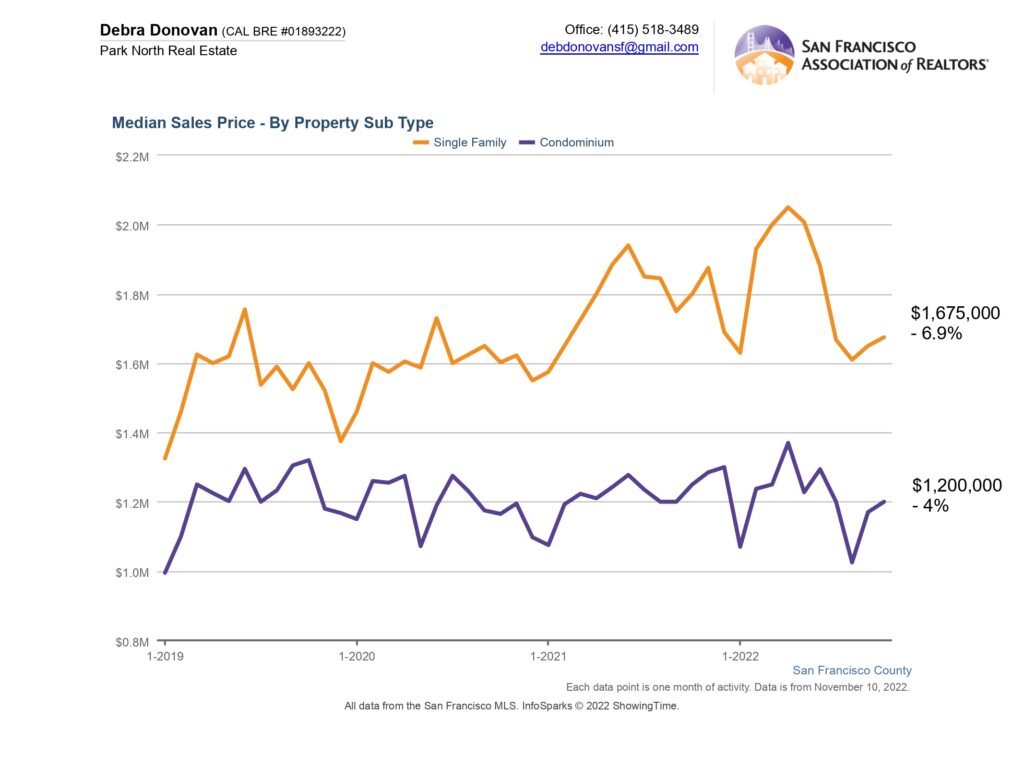
The price for a single family home fell about 7% in October compared to October 2021, making it about the same as the median price in 2020. Condos were also down 4% year over year.

New Listings:

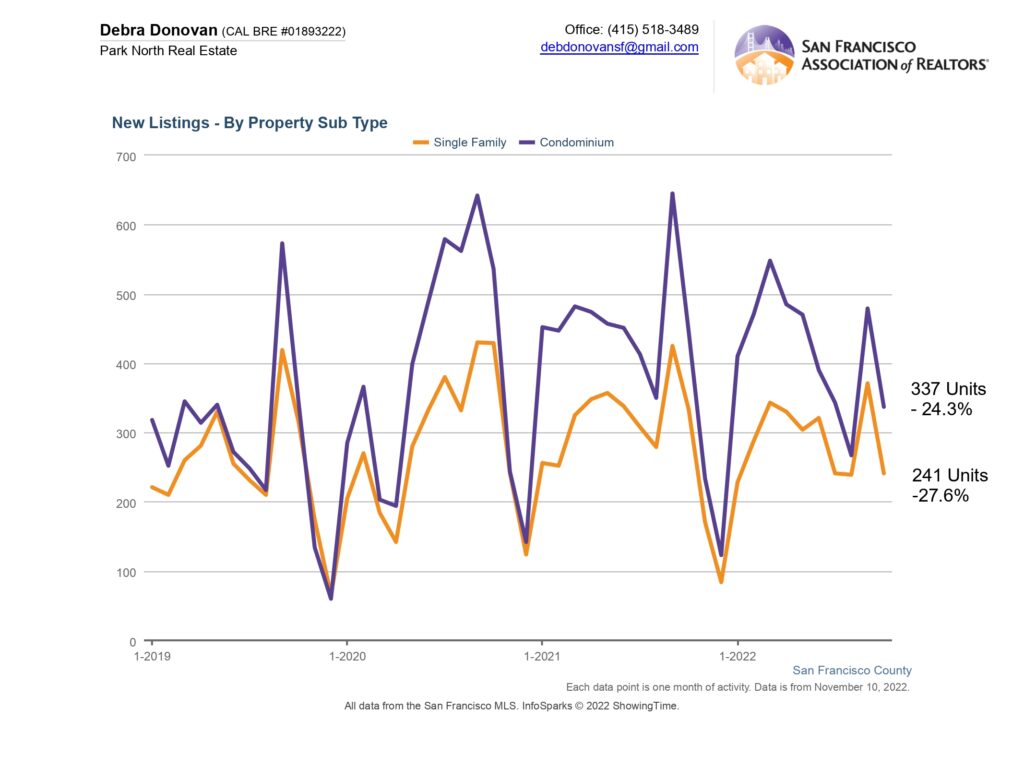
New listing were again down year over year. New single family home listings were down more than 27% while new condo listings were down almost 25%

Active Listings:
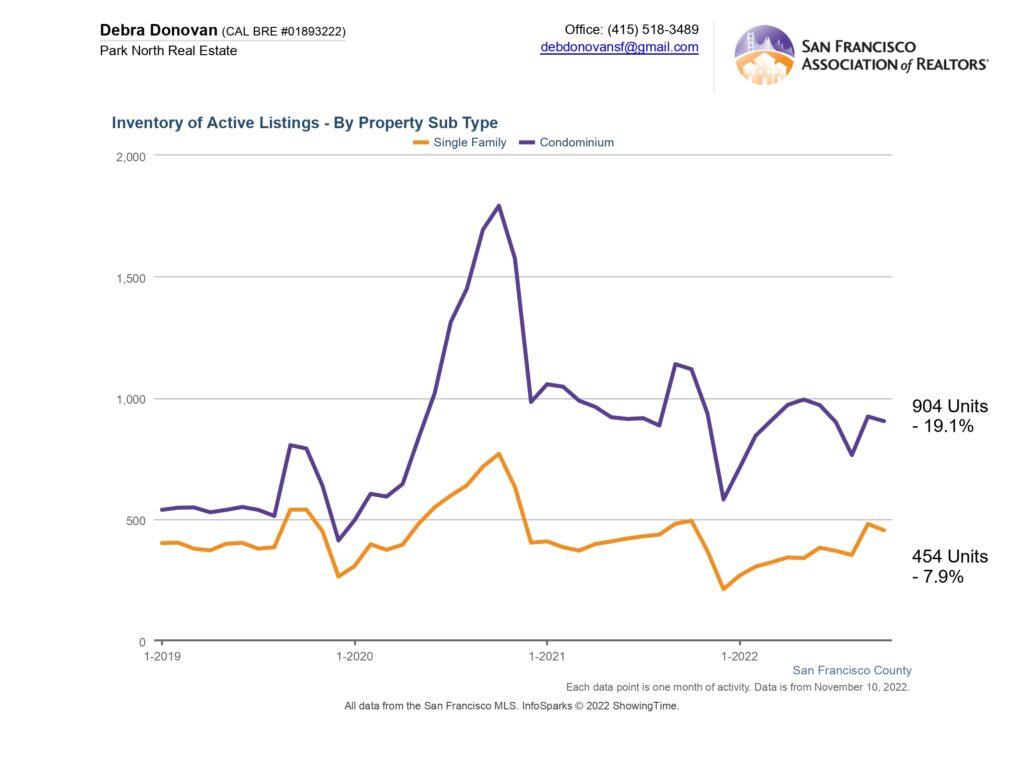
Like new listings, active listings -those still on the market at the end of them month – were also down though perhaps not as low as in the past. Active single family home listings were down 8% while active condo listings were down 19%.

So

Percentage of Properties Sold Over List Price:

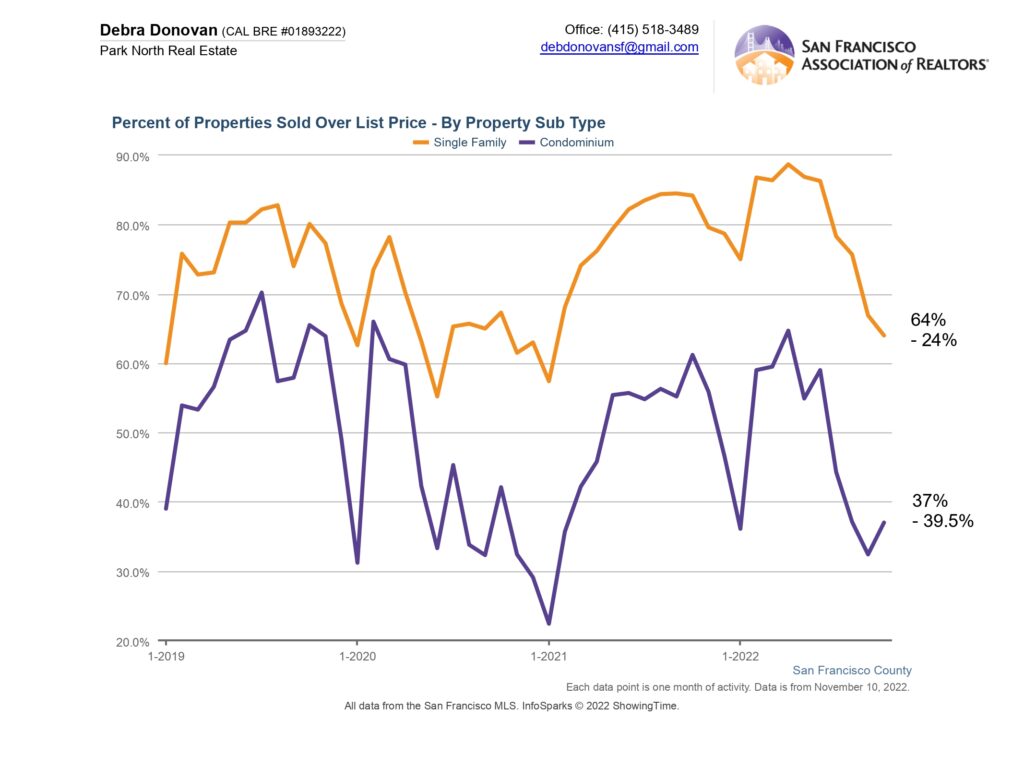
Fewer San Francisco homes are selling for over their asking price. As properties sit on the market a bit longer and competitive multiple offers are not as rife, more homes are selling at or close to their offer price. Though not all. Almost two-thirds of single family homes sold for over their list price in October, down 24% compared to October 2021. Only 37% of condos sold over their list price, down almost 40% year-over-year.

Average Percentage of List Price Received:

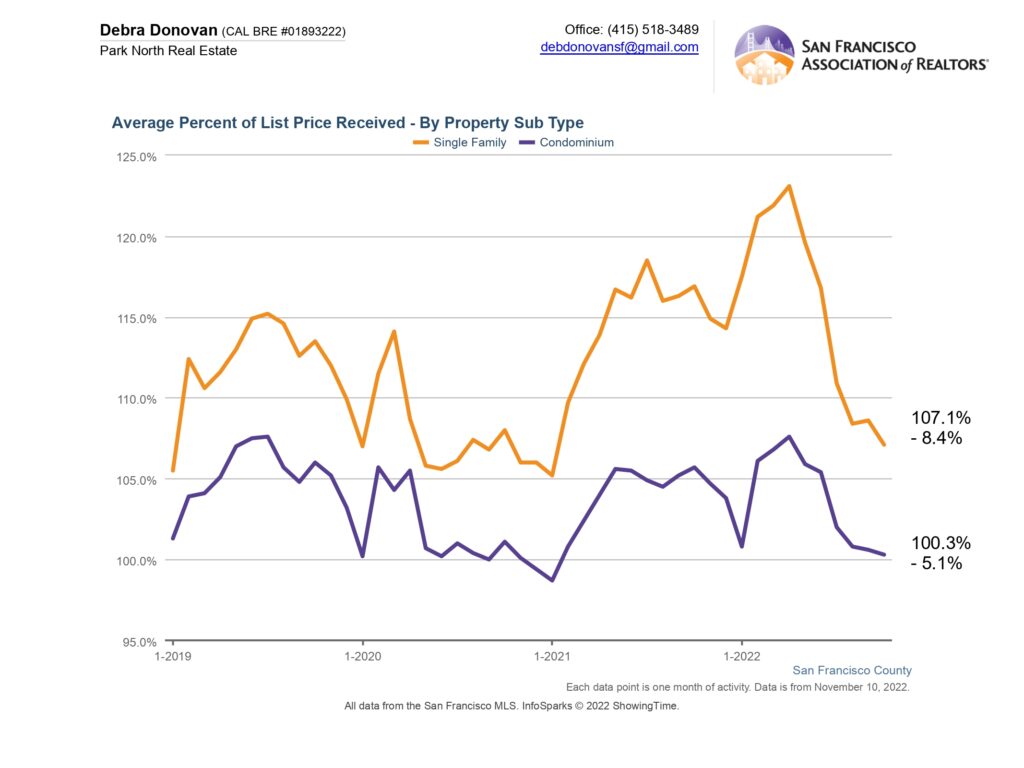
Just as the percentage of homes overall that sold over their list price decreased, so too did the average percent of list price received decrease. Single family homes sold for 107% of their list price in October, down 8% year over year. Condos sold on average for just about their list price, 100.3%, down 5% compared to October 2021.

Months Supply of Inventory:

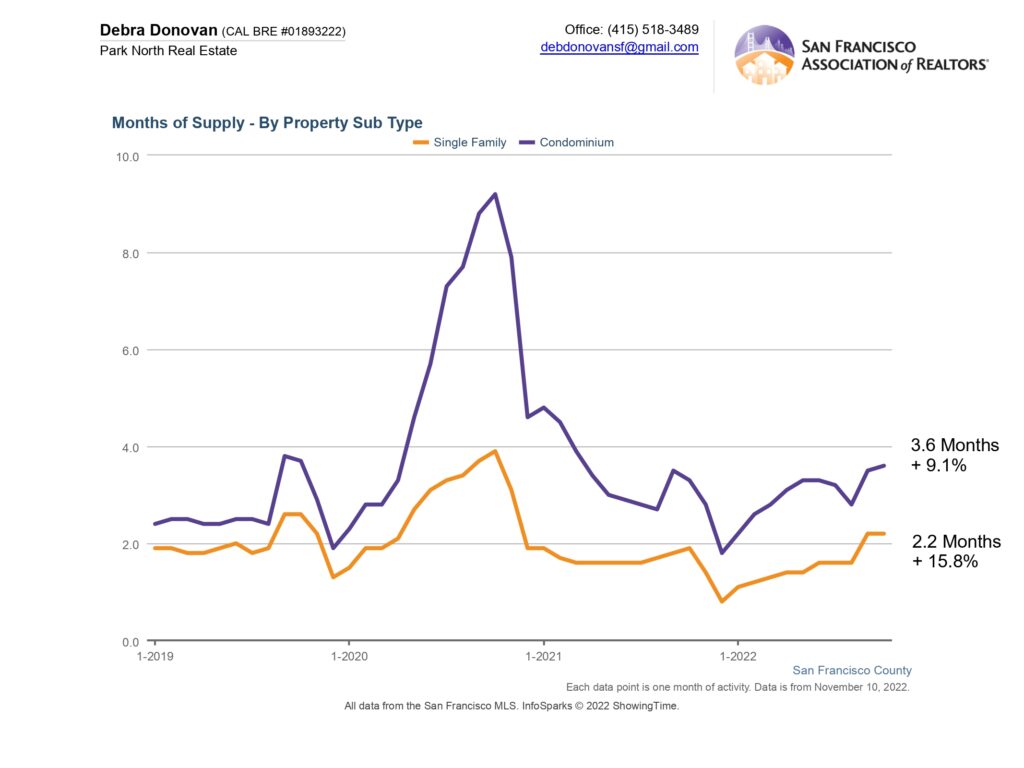
MSI for both single family homes and condos crept up in October. Single family homes had 2.2 months of inventory in October, up 16% year over year. Condos had 3.6 months of inventory, up 9%. To put this in perspective, last October the stats were 1.9 months and 3.3 months respectively, so while the change seems significant it really isn’t.

Average Days on Market:

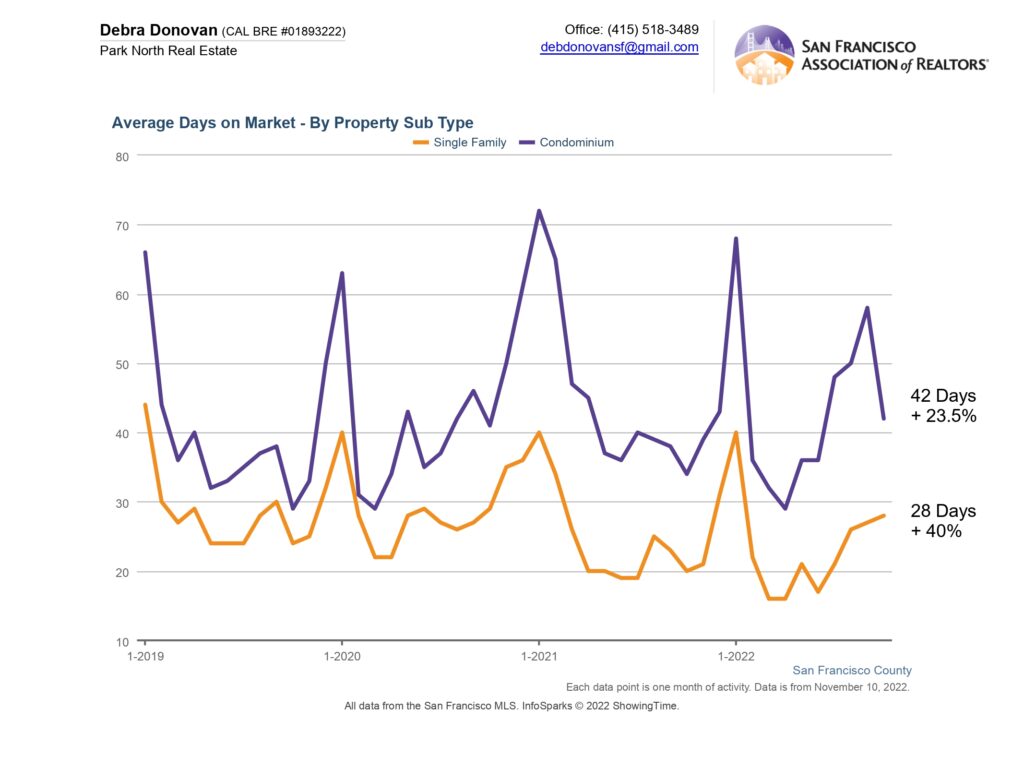
Like months supply of inventory, the average days on market that a property was on market before accepting an offer also increased. Single family homes spent an average of 28 days on the market, up 40% compared to October 2021. Condos spent 42 days on the market on average, up 24% year over year. Like median sales price, these statistics were also about the same as October of 2020.

The fine print: All information deemed reliable but not guaranteed or warranted. Data comes from the MLS so does not include off-market and most new construction condo sales. The Bay Area real estate market is dynamic so statistics can change on a daily basis. These statistics are meant to be a snapshot of the day and time they were pulled.


Real Estate Agent with Park North Real Estate CA DRE# 01893222

Q3 2022 San Francisco Real Estate Market

San Francisco Real Estate

Rising interest rates and a volatile stock market shifted the San Francisco real estate market in the third quarter. Buyer demand waned as their spending power fell while interest rates rose. Seasonality may also have played a role because the summer months are typically slow.

Meanwhile home sales slowed a bit and properties took longer on the market to get into contract compared to the same quarter last year. Even so, we are still in sellers’ market territory here in San Francisco.

Median Price:

The median price for a single family home slipped almost 9%  percent in the 3rd quarter compared to the same quarter last year. Condo prices dropped 5% to $1,147,500.

New Listings:

New listings for single family homes and condos were also down for the quarter. There were fewer than 850 new single family home listings in Q3, down 16%. Fewer than 1100 condos came on the market in Q3, down 22.7%.

Sold Listings:

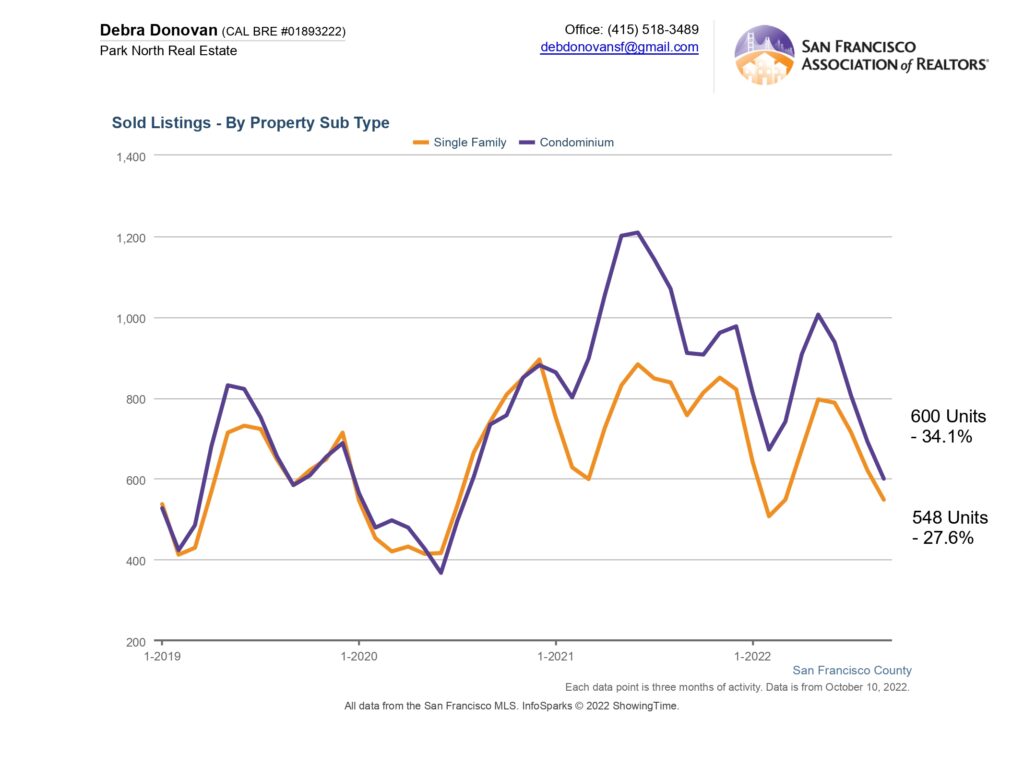
Sold listings decreased for both single family homes and condos. Single family home sales were down about 28% while condos sales were down 34%.

Percentage of Properties Sold Over List Price:

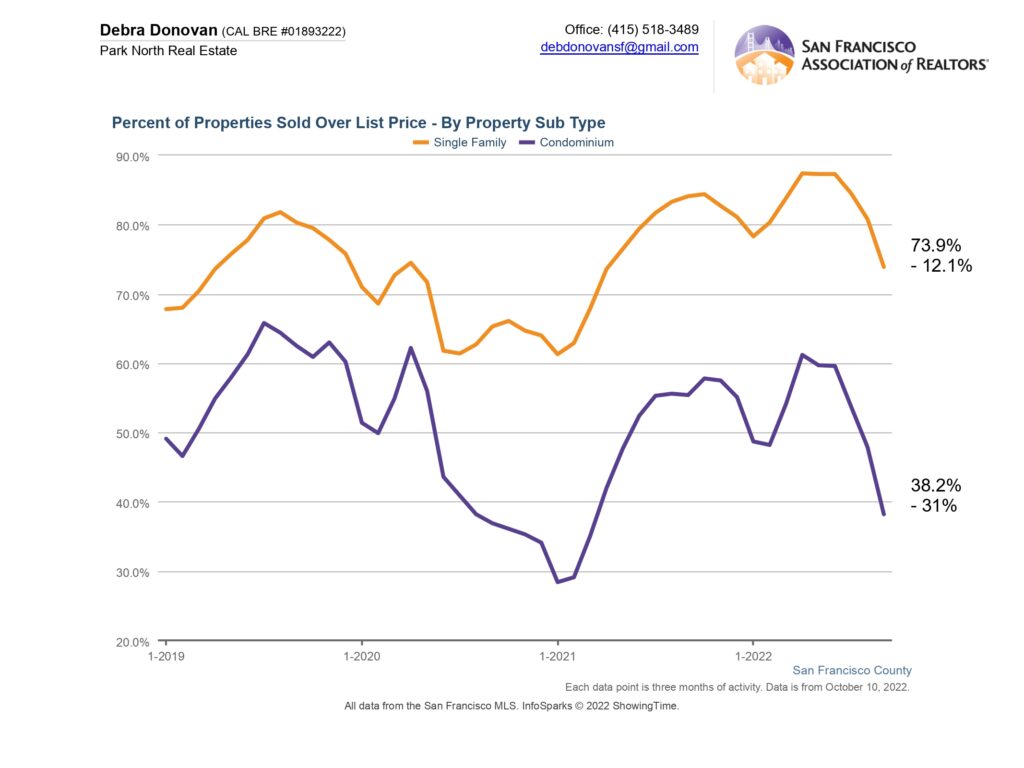
As demand slows and home options for buyers pick up, we are seeing fewer bidding wars for properties, resulting in the percentage of properties selling over their list price to decrease. Just 74% of single family homes sold for over their asking price, down 12% compared to the 3rd quarter 2021. Just 38% of condos sold for over their list price, down over 30%. Seasonality can play a role in this as the summer is typically quieter.

Average Percentage of List Price Received:

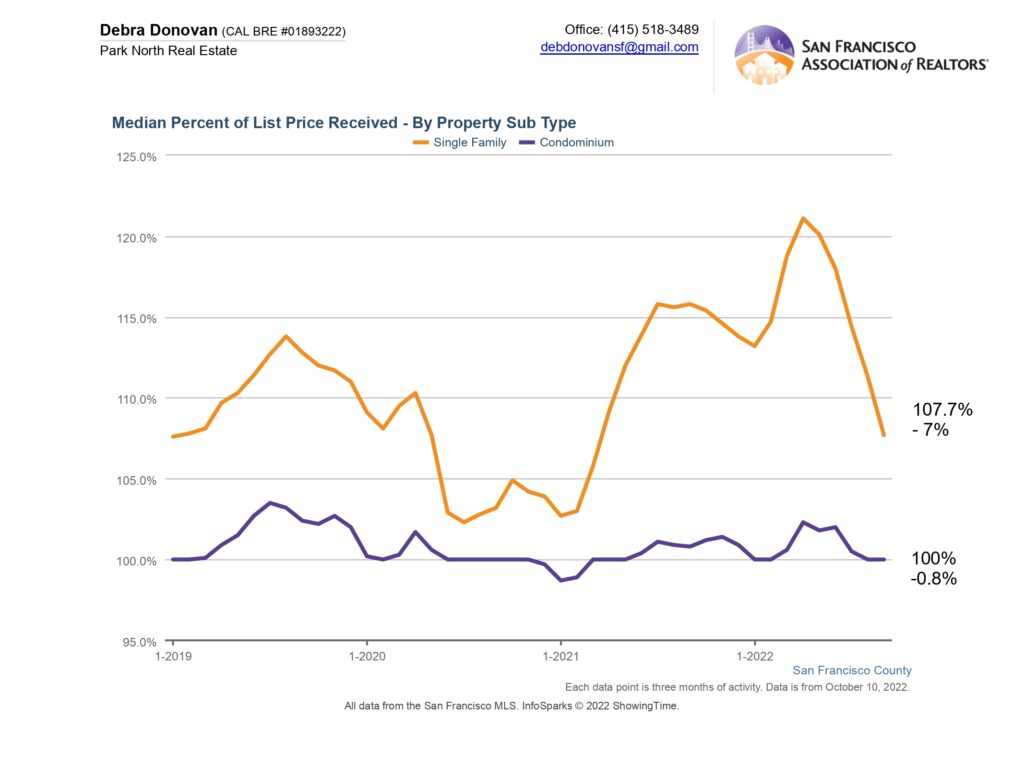
The average percentage of list price received in the third quarter for single family homes was 107.7%, down 7% compared to last year’s third quarter. Condos sold on average 100% of their list price, down less than 1% of what they sold for in 2021.

Average Days on Market:

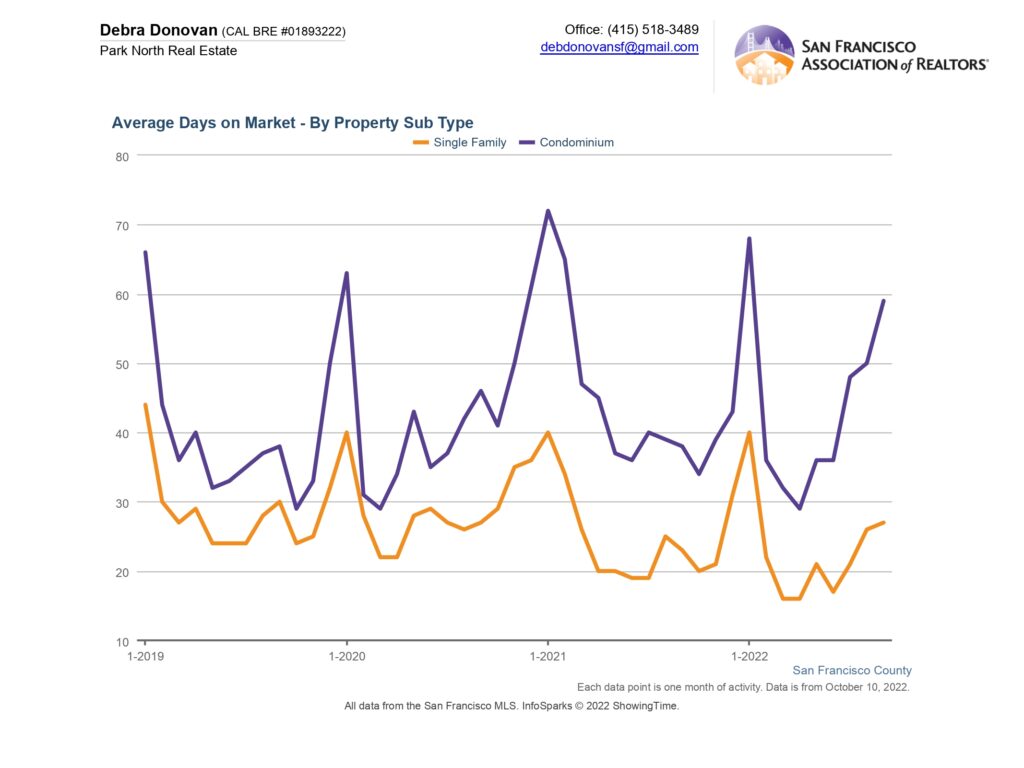
Another indication of the slowing market is homes staying on market longer before accepting an offer. Single family homes spent an average of 25 days on the market in the third quarter, up almost 14% compared to Q3 2021. Condos averaged 52 days on the market, up a third compared to last year.

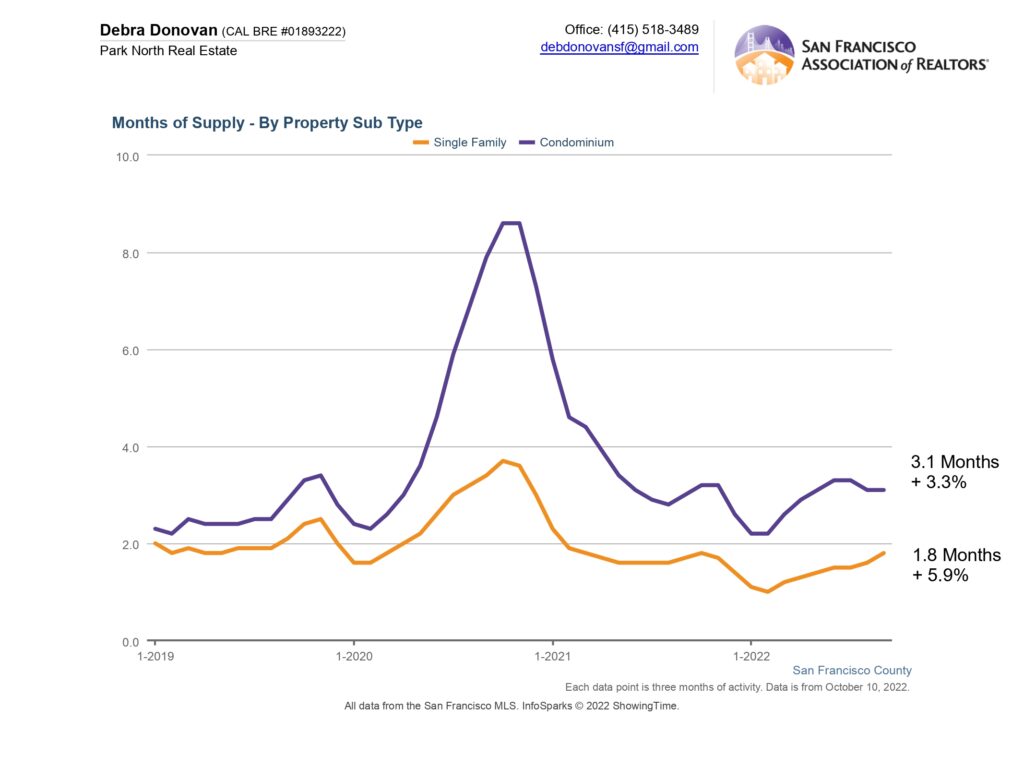
Months Supply of Inventory:

While the months supply of inventory, which illustrates how long it would take for the existing homes to sell through based on current demand, has increased for both single family homes and condos, it remained in seller market territory in the 3rd quarter.

The fine print: All information deemed reliable but not guaranteed or warranted. Data comes from the MLS so does not include off-market and most new construction condo sales. The Bay Area real estate market is dynamic so statistics can change on a daily basis. These statistics are meant to be a snapshot of the day and time they were pulled.